Remanencias is a photographic project directed and curated by Alejandro Ramírez Orozco that explores the ephemeral dialogue between object, architecture, and photography. The project brings together creative disciplines—design, architecture, and photography—to investigate what remains after the encounter: the invisible trace left by a temporary presence in space.
Under a shared curatorial framework, fourteen creators working in Mexico were invited to develop original pieces of different typologies. Each object was conceived not as an autonomous form, but as a body designed to relate, adapt, and be activated in conjunction with others and with the architectural space that receives it.
These pieces travel to four contemporary architectural projects located in different cities across Mexico, each characterized by a strong visual and sculptural presence. At each location, photographic sessions are carried out in which the objects are placed, adapted, and temporarily inhabit the architecture, generating specific compositions that respond to the qualities of the site: light, scale, shadows, textures, and voids.
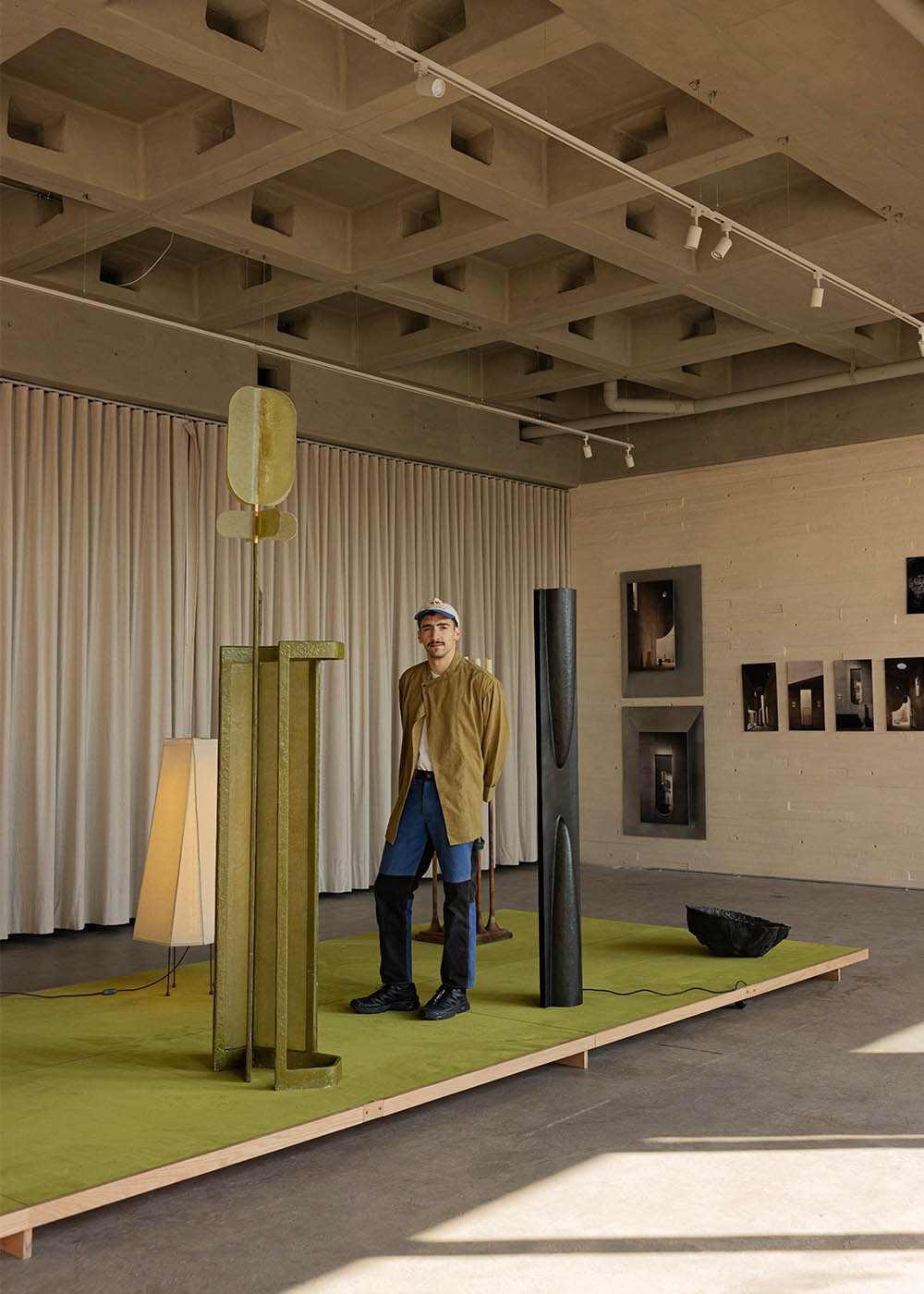
The exhibition will last for two weeks, from February 3rd until the 27th of February 2026 as part of Mexico City Art Week. The aim is to create a spatial experience for visitors: the photographs, framed with special designs by Manu Bañó, engage in dialogue with the fourteen physical pieces placed at the center of the space on a platform. Viewers are invited to move through the photographic series while recognizing, relating to, and rediscovering each object within the images, mentally reconstructing its journey through the different architectural spaces.
What, if anything, remains when an extraordinary set of geographic conditions and idiosyncratic design visions, or—put differently—a particular palette of pieces, places and perspectives, come together for a single sequence of hours—no more than a couple of days, at most—a temporal span and creative constellation never to recur in that exact way? Might the singular slice of time, ingenuity and fortuitousness leave some kind of vestige, a record of sorts, a trace other than in the minds of those who witnessed the encounter?
REMANENCIAS, a photographic essay conceived and overseen by Alejandro Ramirez Orozco but vitally contingent on over a dozen close collaborations, is an attempt at answering the riddle. But instead of delivering clear conclusions, it invites the observer to raise their own questions, inspirations, and interpretations.
The project showcases the work of a group of Mexican or Mexico-based creative talents, from Ramirez Orozco himself to an exceptionally skilled cohort of architects and designers. It’s a canvas composed of multiple components, including images, objects, words, an exhibition, and buildings. While the latter architectural creations aren’t physically present in the final display, their aura is evident in indelibly captured details and fragments. It can also be felt in the way the structures have informed the pieces and pictures that inhabited them. Similarly palpable is the residual charge of a months-long journey integral to Ramirez Orozco’s experiment. Just like no person is unchanged after a meaningful trip, what’s seen here has been forever marked by distant climates, new experiences and serendipitous collisions.
The chosen pieces journeyed to the location of each architectural project, where they inhabited and entered into spontaneous conversations with the homes’ varied spaces. Once the (re-)encounter —with new walls and volumes, local elements and ecosystems, and amongst each other—was documented by Ramirez Orozco’s exacting lens, the pieces continued—caravan-like—to the next setting, only to be staged with the same care but to utterly different results in other rooms and against other characters.
The Mexican territory covers a staggering gamut of textures, from snow-covered peaks to cenotes, past forests, canyons and valleys. That abundance is reflected in the country’s architecture and design, a category living through a golden age —not its first— of which the best examples are steeped in the soil and scars of the region and hands that created them. The houses that received the project in four different enclaves of Mexico’s landscape are more than a mere foil for REMANENCIAS: they came alive with their temporary visitors, perhaps knowing these guests—quiet but sensible, inanimate but imbued with personality, and displaying a familiar attention to proportion and scale—were gentler occupants than the louder, more permanent and invasive users that will soon move in.
Radically dissimilar in character and siting, the four residences have in common being recently completed, still uninhabited yet no longer in construction. Voids are often frame-, window- and doorless. Captured in this ephemeral limbo—as architectural sculptures rather than functioning dwellings– each project speaks for itself with an aesthetic dialect of its own. And yet, a common language emerged: Geometries? Sacred. Forms? Sharp. Presence? Eminently sculptural. Materiality? Concise. Above all, an unexpectedly sensual in situ experience that is striking without being imposing. Ramirez Orozco’s prints preserve the raw, layered and exhilarating ambiance of the sessions that produced them, as the constructions’ naked partitions and chambers were caressed by light and embraced by the participating designers’ inventions.
If the specially designed pieces inhabit the houses with an uncanny mix of grace and assurance, the houses themselves sensitively inhabit a specific environment as if having always existed within it. For REMANENCIAS, context was paramount, as evinced by the project’s photographic record. The series of images, abstract as they may be, channel Mexico’s coastal humidity, the cool air of the country’s plateaus, and the magisterial grid of its colonial downtowns. They report eloquently on behalf of four imminent homes that, barely erected, already exude the genius loci of their locality.
In the scorching heat of Puerto Escondido, surrounded by sand, sea and magical sunsets, a monumental orange-tinted structure that stuns with conceptual rigor and a stepped formal vocabulary that nods to our Mesoamerican past.
In Valle de Bravo’s microclimates, which can instantly swerve from balmy to rainy to chilly, curving lines cut out into the concrete ‘wings’ of private getaway to mimic the shapes of nearby treetops, as brightly colored birds swirl overhead.
In Tapalpa, nestled in Jalisco’s sierras, a contemporary reading of a country casita that sits silently in communion with the land from which it rises, its gabled roofs, patios, and thick walls designed to blend with the color of vernacular tepetate.
In the historic center of Yucatán’s capital and miraculously invisible from the street, a textured concrete shell that responds to the narrow plot barely containing it. A sculpture pretending to be an abode, its segmented pure volumes and soaring hall recall nothing so much as a stripped-down Brutalist cathedral.
Along the way, happenstance joined as a crucial ingredient, as staged scenes were subtly enhanced by, say, the surprising echo of an object’s circular detail in an orifice carved out of the host structure; a lamp’s long shadow drawing playful patterns on a brick floor; or gold-hued sunrays bathing a patch of concrete to create the illusion of liquid matter. At each stop, the improvised meeting of forms and textures, at once related and sui generis, was registered in Ramirez Orozco’s signature abstract terms, with special attention to the play of light and shadows and to sudden apparitions no one could premeditate.
Positioned in selected corners of the potent transitional settings, the designs acquired a novel quality, engaging the surrounding forms and creating compelling resonances. Created at dusk and at dawn and utilizing dramatic effects of texture, luminosity, darkness, reflection, depth, and volume, Ramirez Orozco’s compositions stop time to investigate the unspoken rapport between objects and space. They don’t intend to describe the houses so much as to register their essential traits in dialogue with their passing visitors, probing how the same figures can inhabit, adapt to, and ultimately reshape different spaces, all while sparking unplanned synchronicities. With precision, these painterly portraits recount how design arrived at and transited through architecture, documented only in the memory of a handful of witnesses and an evocative photographic testimony.
The pilgrimage culminates in an immersive physical manifestation of the ideas, situations and dialogues that bring REMANENCIAS to life. These paragraphs and the accompanying imagery—in custom aluminum frames that elegantly allude to the project’s architectural foundations—surround the well-travelled objects presented at the center of a neutral dedicated space, so the viewer can experience the work in its integrity while walking around its material vestiges and taking it in from different vantage points. By then rediscovering, in the images, the just absorbed design pieces, anyone can recreate the Mexican odyssey at the heart of this collective endeavour: a lived story about identity, form and culture, told through the imagination of a country and its vibrant present.
公开 不公开