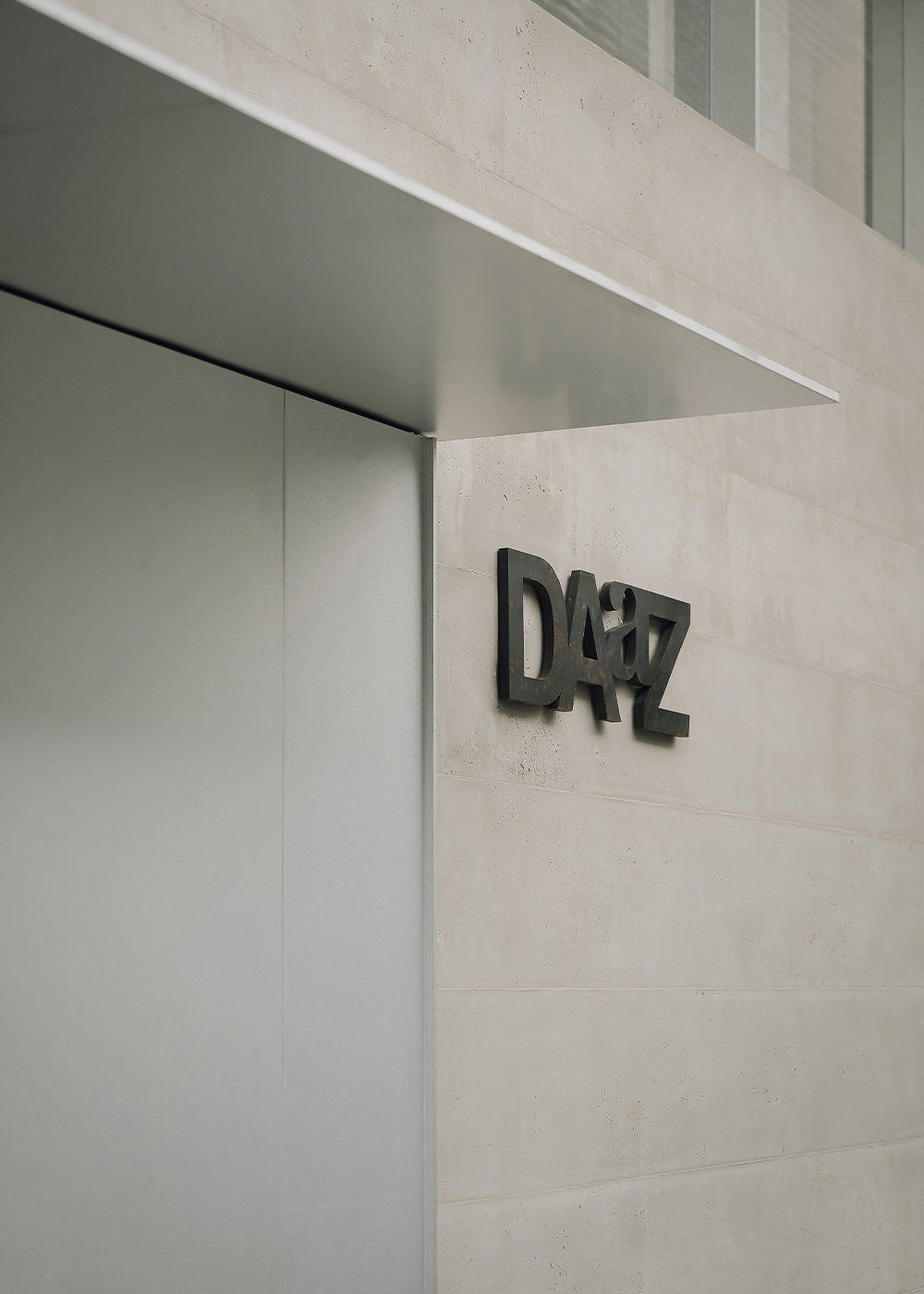
The headquarters space of DAaZ, a pioneering furniture brand in China, located in Dongguan, has recently been officially opened to the public. Here, there is no commercial expression seeking visual stimulation; instead, it exudes a cold and restrained spatial temperament, utilizing the rustic texture of cement and the cold luster of metal to complete a pioneering experiment on the essence of space, brand spirit, and design boundaries.

Cement and metal constitute the most distinctive visual language of this building, permeating the entire space. The rough texture of cement particles exudes a primal tension, while the sleek metal lines outline a coherent sense of order and beauty. These two seemingly everyday materials collide to create an unexpected spatial ambiance, which is both primitive and avant-garde.

The extensive skylight allows abundant natural light to penetrate the space, and horizontal and vertical lines create a clean and neat spatial order. The influx of light injects a sense of openness and breathability into the gray and cool palette. The leisure area by the window is bathed in light, and under the pervasive aroma of the aromatherapy display wall, it forms a soothing presence.
The entire building resembles a "former industrial site" that has been reawakened. Unlike the previously soft and warm spatial image, this new space completely breaks away from the established image, returning to the essence of architecture with a cold and rational expression. It strips away excess decoration, allowing the structure itself to be the expression. The exposed beams and pillars, as well as the unadorned walls, all convey a sense of "visual honesty".

Exposing the original texture of building materials directly is the core of this spatial design experiment. In this space, which primarily displays collectible design furniture, the entire wall retains the initial state of the building, with its mottled texture and stacked bricks, resembling a huge and silent work that quietly tells the story of this building's past, and also forms a silent dialogue with the works displayed on site.

This "visual honesty" is not only reflected in the use of materials, but also extends to the design of the entire spatial structure. The lofty attic, the original form of the concrete display platform, the rugged texture of the structural columns, and the natural patterns of the walls all seem to be the inherent appearance of this building, rather than the traces of later artificial "design", giving the space a strong non-standard aesthetic and a wild sense of freedom.

In this space, the view is never fully revealed at once. From the entrance, every step reveals a new scene, inviting people to actively explore. Rather than a dazzling array of products on display, it prefers to use a layered visual rhythm, allowing the audience to unlock more surprises as they move from one scene to another.

Here, restraint is not a limitation, but rather a way to allow all perceptions to manifest more purely. When external distractions are minimized, people's attention can instead be more purely focused on each individual work.

As a furniture brand that has always been committed to exploring the boundaries between furniture and art, DAaZ never caters to established aesthetic standards. Instead, it endows furniture with an independent and rebellious avant-garde expression through experimental shapes and craftsmanship textures, offering another possibility for those who are not satisfied with "just enough". This attempt at the headquarters space echoes the brand's increasingly experimental product trend at present, and also indicates bolder and freer works in the future expression.

MORE PHOTOS