Beyond vacation, what can we offer? Through continuous co-creation and boundless thinking, we strive to deliver the answer. Thus, upon the lively coast, a seemingly untimely “rebellious” building quietly descended, borne on the warm currents of the subtropical climate. It does not offer an affirmative reply; it only provides a field for contemplation and a path for seeking. With an ordered silence, it resists the clamor and transience of external information. Its very existence is itself a declaration: some values cannot be simplified by algorithms; some thoughts still shine like a lighthouse.

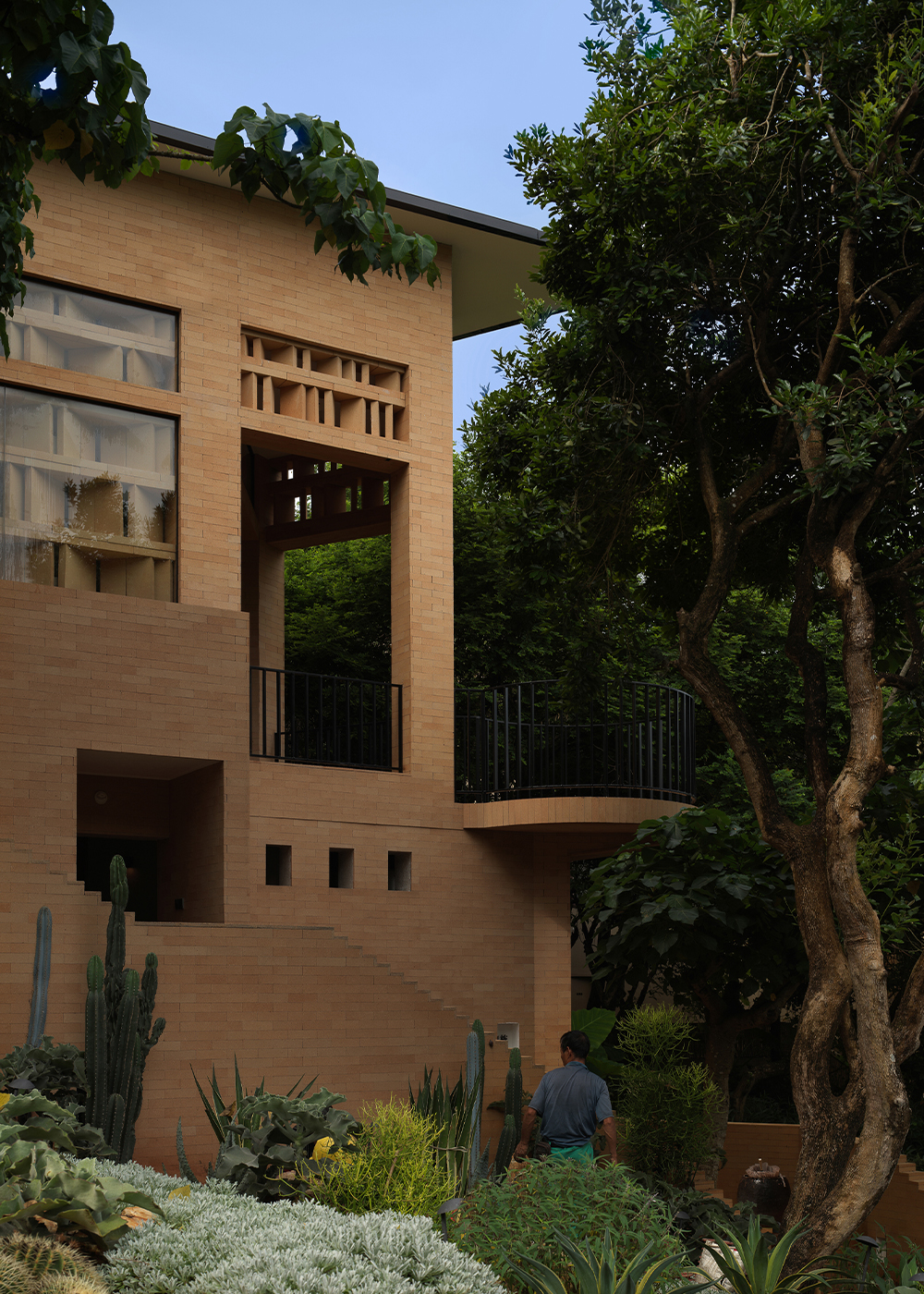
This is a secluded library, standing quietly between the blue sea and green mountains of Yuganwan, Nan’ao Town, Shenzhen. Books endow it with a unique functional character, while the interweaving and reconstruction of geography, human culture, and nature point, on this basis, toward an entirely new spatial relationship and emotional significance. Stepping into nature, and following the contours of the mountain and the veins of plant growth, irregular geometric openings are cut into stair-like buttresses resembling a city wall, welcoming visitors amid the flickering shadows of greenery. Concealment and revelation are juxtaposed; the architecture seems to grow from the mountain itself, becoming a continuous part of nature.

With a two-story structure, the building shapes a vertical tension. The ground-floor service area is tightly enclosed by brick masses, allowing the service spaces to be softened and hidden away. Ascending the steps, the second floor is built in clay brick to form a perforated interface, creating a non-enclosed sequential structure. Light, as a soft medium, dissolves the boundary between inside and outside, while the space achieves a subtle balance through the mutual generation of solidity and void, creating a reading atmosphere that is light yet focused.
The design unfolds in a fan shape, breaking the enclosure of the box and embracing nature with an inclusive gesture. The converging sharp angle is like a compass, silently pointing beyond the terrace toward the place where the curve of the sea meets the horizon. Sight and mind are led together toward the boundless distance, where the spirit completes a free wandering. Within the fan shape, a huge round window is quietly embedded. Daylight flows and circulates among the wooden beams, turning to illuminate different planes and corners. The arc is like a ring of time, linking past and future. Words float and roam here in stillness, as if fixing eternity in a single instant, while also suffusing the space with an atmosphere detached from reality.

Extending the “V”-shaped semi-transparent sequence of the architectural plan, the ceramic bricks form a dual entity: both wall and bookshelf. While fulfilling its own structural narrative, it also provides a natural haven for the books. With their spines facing outward, the volumes stand quietly within the undulations of the brickwork, appearing as if they have grown organically from the material itself.

When words dwell in clay, the wall surpasses a single definition and becomes the poetic language of the space. Its vertically folded form is like pages unfolding, and its undulating texture resembles the cadence of alternating tones in verse, echoing in depth and rhythm the breathing pulse of the distant sea. Only when function and image overlap in the same carrier does the space truly gain a poetry that can be read.

When space is redefined by architecture, architecture too, in its dialogue with people, nature, and place, is endowed with meanings that go beyond material function. Just as with the Sanye Library—it is a functional container, but also a carrier of inward experience. Through the collaboration of material, light and shadow, and structure, it guides people back toward introspection, allowing them once again to sense the depth of happiness and the breadth of existence.

Passing through shaded woods, one arrives at a secluded courtyard built of stone and wood, gently separating the noise of the world outside. The hidden sense of enclosure gives an initial peace; and the operable screens of natural bark leave breathing gaps between shielding and openness—wind may enter, light may enter, the sea may enter, and the heart too may rest.

The layered sloping triangular roof is the first deep conversation between the architecture and this land. Its form both echoes the undulating waves in the distance and metaphorically suggests the sails of fishing boats returning to harbor. It grows from mountain mist and sea haze, forming a distinctive geometric dialogue with the square and upright door frame. In the interweaving of vertical and horizontal lines, it sketches a “material poetics” of mountain, sea, and human culture.

Stepping inside, a plain and rustic charm gently envelops the visitor. The space removes embellishment, allowing perception to return to its original state. At its core is a tea seat openly facing nature; aside from a few plain utensils, there is nothing else. Both inside and outside are empty, leaving only the guest—daylight, guided by the triangular roof, comes lightly to rest, casting mottled warm tones into the human heart.Renewable reclaimed timber boards, rough clay, and plain stone are carefully woven into the texture of the space, spreading outward and overprinting traces of former days. Much like the depth of Eastern tea, they grow richer and mellower with time.

Unlike the traditional tea room, which completes inward contemplation through an introverted spatial order, the Shanye Tea Room receives all things through an open artistic conception. In the moist, faintly salty touch carried by the wind, and in the breathing shared by tea, woodland, mountain, and sea, it constructs a spatial field that is deep and gentle.

A transparent glass interface replaces the solid wall, allowing all things in nature to enter unobstructed. Light and shadow spread across the tea setting and utensils, tinting the hazy traces of time as it quietly flows, while also gradually dissolving the social boundaries carried within the heart. As brightness and shadow transition across the space, the emotions quietly settle, and the spirit thereby gradually enters a clear brightness.

MORE PHOTOS