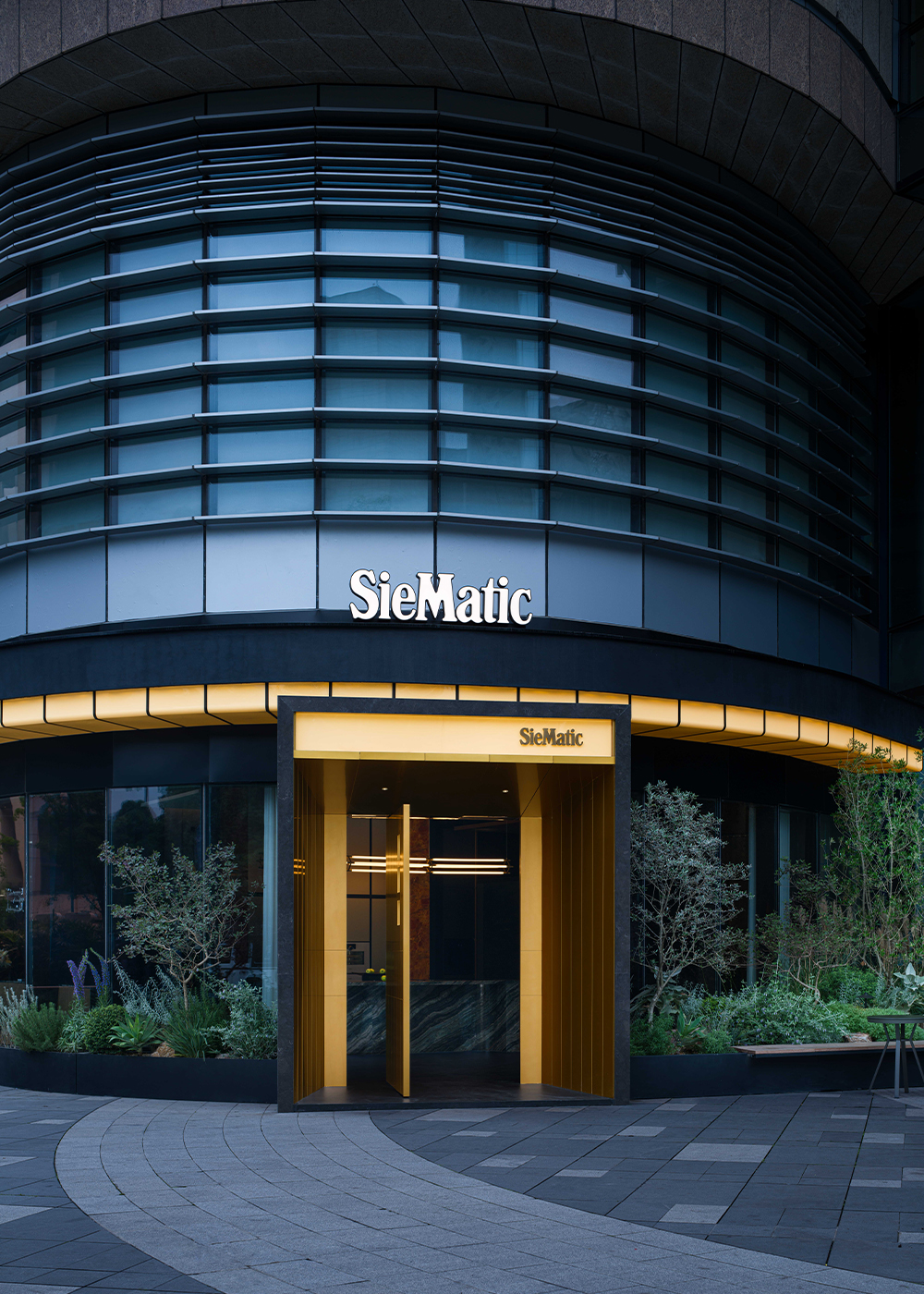
SieMatic is a premium German kitchen brand. When the design center at the German headquarters approached us to collaboratively complete this showroom located in Chengdu, we first asked ourselves: How should a century-old German brand present itself to the public in the local context of Chengdu?
The essence of German design has never been the romantic and ornate style characteristic of Italy. We believe it should be crisp, precise, and stable—an aesthetic rooted in functionality and practical logic. This character can even be traced back to the tradition of German classical music. Bach's counterpoint, Beethoven's structure, Brahms's rigor—behind these great names runs a spiritual thread spanning centuries: meticulous composition, mathematical internal relationships, and a sense of logical order. This deeply resonates with the core values of German design. We have decided to base this design on modernism.
The design of the storefront serves as the overture to the entire exhibition hall. Taking the 52 white keys of a piano as our prototype, we use lighting interventions to transform them into a play of solid and void on the building's façade. This is not a mere decorative reference—the inherent rhythm within the ordered restraint of piano keys becomes a material translation of German design philosophy.
Entering the exhibition hall, the spatial circulation is organized into two parallel pathways. One is open and free: clients move casually among different kitchen settings, as if browsing through the pages of an open product catalog. The other is private: a secluded reception area is situated deep within the showroom, enclosed and quiet, allowing conversations to continue undisturbed throughout an afternoon. These two paths run parallel at times, and converge at others—like two distinct voices in a polyphonic composition.
We stripped the space of unnecessary shape. SieMatic's products arrive with their own completeness — they invented the handle less cabinet, after all. Function and form were never separate to begin with. Our role was to step back. To make room. Stone, metal, wood — materials that speak the language of building itself — form the barest skeleton of display. Nothing competes. This is not minimalism as style. It is Bauhaus as a living principle: form follows function, space serves what it holds. And yet, this precision is not cold. The warmth of timber, the cool texture of metal, the weight of stone — they hold a temperature the hand can register. The eye reads order. The body reads warmth.
Returning to the quality-oriented local consumers themselves, what exactly do they expect from a premium kitchen showroom? We believe it is the freedom to experience products firsthand, along with a private and in-depth communication environment. This "dual-track" spatial logic is the only answer. At the same time, it also functions as a social venue. The kitchen is inherently the foundation of daily life, so its usage scenarios should naturally become the core of the entire showroom experience. This approach is made possible through our deep collaboration and mutual understanding with the SieMatic global design center—where the German design team contributes their profound understanding of the products, and we bring our authentic insights into the local market. These two threads converge here.
A good exhibition space does not preach, but moves people through deep immersive experiences. We hope that everyone who walks into this space—precise in character yet consistently warm—can feel the inner order of German design: not a cold, mechanical precision, but genuine emotion expressed through the rhythm of order.
公开 不公开