The studio founded by Gonzalo Sánchez Ortega and Armando Diago intervenes in San Sebastián to bring the Centro de la Memoria (Memory Center) to life. Located on a 600 sqm ground floor originally characterized by its darkness and structural density, the project arises from the need to reconfigure the site, placing the model of care and spatial quality at the center of the architectural equation.

The intervention begins with a rigorous reading of the pre-existing state: a space interrupted by a dense grid of pillars that, far from being concealed, is utilized as an ordering framework. Ortega Diago accepts this "forest of pillars" with a smooth finish as the rhythmic counterpoint to the new volumes that compartmentalize the floor plan.

The design commits to a tactile and expressive materiality: the new partitions are clad in a rough, coarse-grained stone texture, endowing the walls with a haptic quality that breaks away from the habitual clinical sterility of healthcare environments. This dialogue of textures is enriched by the incorporation of stainless steel in the service and locker storage areas; a technical material that introduces sharp glints and diffuse reflections, amplifying the luminosity of the interior space.
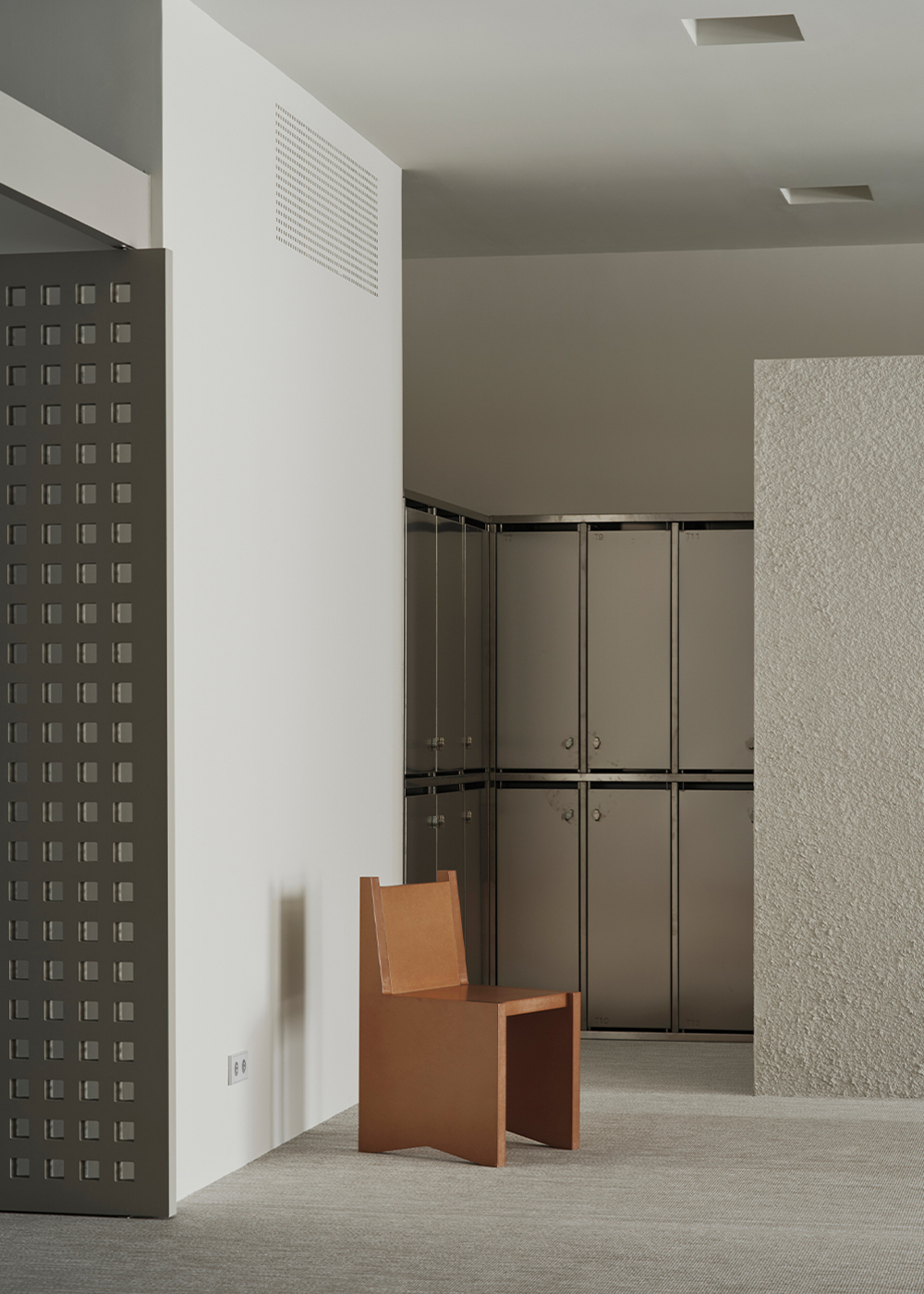
The flexibility of the program is resolved through a system of large, perforated pivoting doors. These architectural elements surpass their dividing function to act as dynamic solar filters. Natural light, upon passing through the grid of the doors, draws a trail of shifting geometric shadows across the pavement. The architecture thus functions as a mechanism that registers the passage of time, allowing the perception of the space to shift according to the incidence of sunlight throughout the day.

In response to the surrounding urban environment, where stimuli are constant, the aim was to generate an atmosphere of serenity. A veil of curtains runs along the perimeter, functioning as a soft visual and acoustic barrier that isolates the space from street noise. Spatial continuity is achieved through a textile-appearance flooring in sand tones, which provides walking warmth and acoustic comfort, reinforcing a domestic sensation over an institutional one. The project is completed with a careful selection of furniture featuring architectural lines and noble materials, such as wood and leather, which balance the scale of the space by adding warmth.

The project addresses circulation not merely as transit, but as the backbone of the experience. Under the premise that "life is a journey through time", the gentle labyrinth where rooms never fully close. The filtered light, the rough materiality, and the order of the pillars guide the user in a fluid walk, allowing them to rediscover the center each day.
With two differentiated accesses — one for users and another for staff and offices — the Centro de la Memoria is established as a protected environment where architecture accompanies and cares for its occupants.

MORE PHOTOS
