Having witnessed the outstanding designs that are popular worldwide, I am deeply moved by the thoughts of the designers in these designs. They either flow in a simple and wise manner, full of spirituality; or focus on the metaphors of history and culture in the site, being profound and humble; or use design to pay tribute to life, demonstrating the wisdom of "learning"... But all of this still fails to change the monotonous and formulaic perspective that designers adopt when thinking about space. Therefore, we urgently need the emergence of a "new design", which carries a perspective on life to engage in competition and collaboration with the market, and to "win the experience and win the public".
From a sociological perspective, diversifying design methods might be one approach. However, there are many ways to achieve diversification. In terms of their impact, spatial design takes the lead! The self-use office space designed by the renowned Chengdu design company "Runshen Natu" for "Fushenmei Home Furnishings - Tianfu" is an experimental attempt that uses aesthetics as the language to explore how to make the senses clear through physical sensations and visual perception.
In today's increasingly diverse world, our perspective of the world has become more and more "self-centered", presenting a "superimposed" state, and showing more "lifelike" and "biological" characteristics. In the "Fushenmei Home. Tianfu" and "Runshennatu" design studios, during the entire process of designing the self-used office space by design director Li Xue, he used distinct living characteristics and gentle, delicate traits to make the space shine with the brilliance of "feminism", leaving a bright spot in the increasingly life-oriented space types.
In my opinion: Beauty is diverse rather than absolute. Otherwise, the tragedy of "southern oranges turning into northern pears" would not have occurred. Therefore, pure, metaphysical beauty does not exist in reality. When we view "beauty", it is not just the certainty of "no matter how the world changes, I remain steadfast", but rather the perception of the brilliance and desolation of life, and only the "beauty" that comes from the heart, derived from life, and embraced in daily life has the constant vitality and durability.
The office space of "Runshentatu" is undoubtedly beautiful. However, this kind of beauty is not the kind that generates the pleasure of "dopamine" under a strong visual impact. Instead, it is a kind of "soft and gentle" beauty that can only be felt when you are in it, coming from the body's perception of time and temperature. It is a kind of "subtle and imperceptible" beauty. We cannot measure beauty with only one standard scale. Regarding the space, we are increasingly attracted to different states of "micro-visions". There are both the grandeur and rationality of male thinking, as well as the gentle, emotional and inclusive nature of "feminism"; there are also the young lifestyle and global perspective, as well as the wisdom of the elderly, with memories and the gentle warmth of time after embracing them... 。 Therefore, we believe that all designs should possess "human" characteristics, and should incorporate the dimensions of "life", "nature" and "daily life".
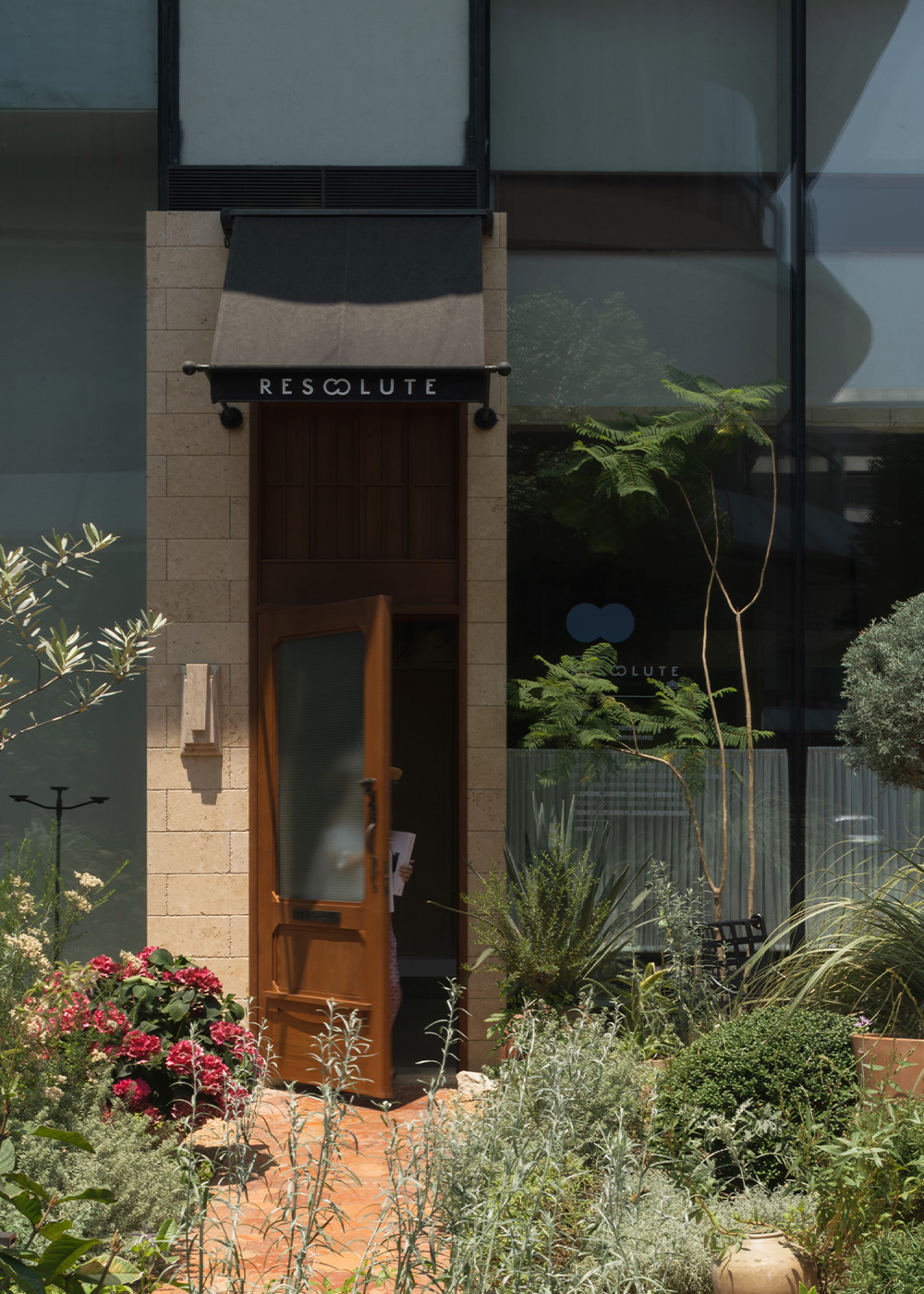
The comfort of the space in the "Runshentatu" design studio begins with the outdoor mini garden. The 9th building of "Fushenmei Home - Tianfu" is an extremely restrained small building, within which there is a showroom with doors and windows - the Jin Zhishangpin exhibition space, and the mini garden serves as the entrance to the "Runshentatu" design studio. It also has the function of regulating the rhythm of the space. In the planning of the studio space, the design director of "Runshentatu", Li Xue, designated the part of the building that acts as a "supporting role" as two floors, totaling 150 square meters, as the office space for the "Runshentatu" design studio. She also redefined the working state and time boundaries of the designer, allowing work and life to blend perfectly, making the atmosphere of the studio become a part of the designer's life.
In the planning of the studio space, the design director of "Runshentatu", Li Xue, designated the part of the building that acts as a "supporting role" as two floors, totaling 150 square meters, as the office space for the "Runshentatu" design studio. She also redefined the working state and time boundaries of the designer, allowing work and life to blend perfectly, making the atmosphere of the studio become a part of the designer's life.
In order to eliminate the cramped feeling of the original space, the designer redefined the rhythm of the space and sacrificed the original order of Building 9, allowing the studio and the exhibition hall with windows to coexist under one roof with two different logics. Neither is subordinate to the other. Therefore, the designer adopted the method of entering through the outdoor courtyard, integrating the outdoor space with the indoor space. The light changed the path of entering the room. In the sunlight, the studio had a vibrant scene. The plants, reflected by the antique furniture, seemed to grow from the ground, and everything appeared radiant. The designer utilized the setting of plants, the relationship with the half-height staircase, and the worn-out traces on the wall to form a wandering path, allowing other designers in the studio to relax and feel at ease here, spending a day's time.
As an outstanding space designer, Li Xue possesses a rather advanced ability to empathize and transform feelings. In her design philosophy, the attributes of spaces are never a mechanical relationship between "active" and "passive". She believes that: Design is an industry that requires free thinking. Any restrictions imposed on designers may turn into shackles for thoughts, making the design become mechanical and unfree.
Li Xue first redefined the way of "Renshenatuo" design office work: Design does not necessarily require "isolated" sitting at the desk and working in isolation. More importantly, social interaction and communication are needed. As long as there is a place to sit, that place becomes the working environment for the designer. Therefore, he abolished the traditional concept of "workstations", allowing designers to stand, sit in the posture that feels most comfortable to them, communicate and discuss, even gossip. At this time, a rich atmosphere of life surrounds and fills the designer's behavior.
Based on this, the designer regarded the entire space within the building as a "living entity" that breathes, and the space became a framework for emotional narratives. It was filled with human activities and social content. The space became an "element" of equal importance to materials, forms, and atmospheres, rather than a "condition" of reality. The chains that bound the designer were unlocked.
Although the "Runshentatu" design studio is only 150 square meters and spans two floors, in the hands of the designer, it fully showcases the important territory of female designers' sensibility, delicacy and abundant imagination. The designer will express the rhythm and beauty that they have comprehended in life in the most personal and daily way, without preaching, without lofty theories, and without proposing any "ideology". Everything is straightforward, growing in the wind, natural and smooth, but it also reveals a truth to us: for the spaces or objects that we use at any time, we should not make the sense of ritual or the design traces too strong, because it will "counteract" our behavior and prevent us from being calm and focused.
As I continue to write, a thought suddenly emerged in my mind: Are we discussing the design concept of designer Li Xue's Runshen Nantu Design Studio in Building 9 of "Fushenmei Home. Tianfu"? Clearly not! Because this office space has an overly obvious "signature feature" and lacks "universal" value. However, the design philosophy held by the designer in this design is something worth our consideration.
公开 不公开