V Taller always regards emotions as the source of creativity – it stems from ancestral memories and also responds to contemporary cultural needs. The construction of a dwelling is an action that requires both knowledge and responsibility; only through interdisciplinary collaboration and a conscious architectural perspective can it be supported. For them, Babel is both an integration and an opening: on the design framework that establishes an active relationship with the environment, this relationship is expanded to a larger scale. The project emerged within the context of what they understood as a "blank canvas", which is not a freedom of form but the very challenge itself: the site lacks any interactive natural framework. This reality prompted the design to recalibrate at the strategic level, with a clear and firm core objective: to restore and return the jungle as much as possible.
In Babel, the spatial experience and environmental energy are based on the same set of spatial logic. By minimizing the building footprint and creating a high vegetation density on the originally barren site, the central courtyard truly becomes the social core and a microclimate regulator. V Taller takes the layered experience of forests and jungles as a reference - life exists in layers, and light is filtered layer by layer to enter; translated into architecture, the transitions formed by different heights and vegetation densities enable those who walk through, stay, and rest to have continuous and diverse spatial perceptions. In their view, the most important thing is precisely these transitions generated by the participation of nature.
Babel is born as a response to a residential and hotel project in Tulum, Mexico, with a clear symbolic and formal premise outlined by the client —a tower and an architectural language articulated through arches— that, when confronted with the territory, transforms into an ethical statement: to build with climate, with time, and with vegetation as matter.
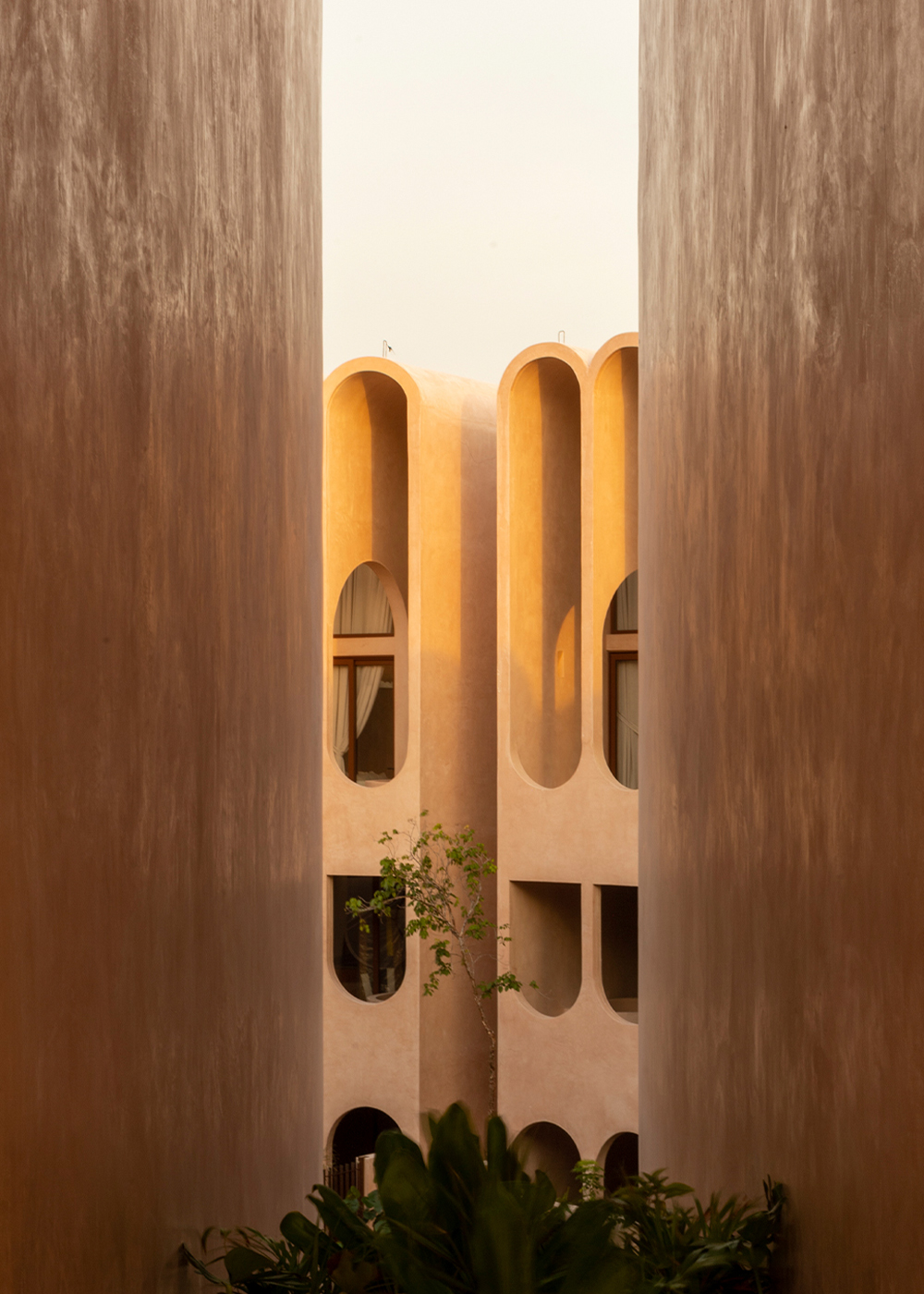
At the urban edge of Tulum, where tourist pressure has caused deforestation and infrastructural strain, the site appeared surrounded by jungle, with virtually no urban impact; except for a prior trace of intervention on the lot, the surroundings remained intact. In light of this, the project ceased to be merely the materialization of a volumetric idea and became a deep reflection: how to build without cancelling ecological logic? how to add environmental value without sacrificing spatial clarity? how to anchor a touristic and residential program to a territory that demands prudence, repair, and continuity?
The response was formulated as a stance rather than a gesture: to rebuild the bond between the built and the natural, to return life to the place, and to reinsert it respectfully into the ecological matrix that surrounds it. Babel thus aspires to be both refuge and ethical declaration, a flexible and sustainable framework of cohabitation that anticipates climatic, social, and economic transformations without becoming an isolated enclave. The goal is not simply to enable a habitable complex, but to propose a long-term canvas where human life and the ecosystem find balance and a shared rhythm.
To sustain this intention, the key decision was not to expand the footprint, but to retract it: to concentrate density vertically, to return land to the jungle, and to turn emptiness into an environmental regulator. Instead of deploying horizontal corridors that multiply impermeable surfaces, circulations are grouped in highly efficient vertical cores. Thus, the project develops 6,176 m² of built area on a 3,510 m² plot and limits its effective footprint to 2,155 m² —a strategy that reduces land consumption by nearly 40% compared to horizontal schemes—, promoting aquifer recharge by preserving permeable surfaces and reforestation zones.
With this principle, the layout was conceived: two complementary curves form an eye-shaped plan that embraces a central void. This void —a courtyard, a microclimatic regulator, and social heart— organizes the whole and gives it a recognizable pulse. Around it are arranged 59 units across three levels, combining residential and hospitality uses to sustain life throughout the year without falling into touristic seasonality.
The mix is not a commercial strategy but a grammar of habitability: kitchen, living-dining area, bathroom, garden with jacuzzi, and bedroom are modulated according to their position along the curve, so that each dwelling fine-tunes its openness and shading to the site’s specific condition, reinforcing continuity between interior and exterior.
The tower requested by the client finds its exact place in the geometric centroid of these two curves. It does not impose itself as an arbitrary landmark; it organizes, orients, and orders. Its presence is neuralgic: it structures movement, provides an axis of reference, and at the same time respects the courtyard’s fluidity. The interior of the tower reinterprets the tradition of the hammam: rigorous control of light, sober materiality, and atmospheres conducive to introspection. Small overhead openings filter natural light and allow the day to draw a changing relief of shadows. The cylinder culminates in a triangular opening that functions as a stargazing lookout; the gaze is isolated from lateral distractions and rises, clear, making the sky another material of the project.
公开 不公开