At the end of September, the early chill of winter already permeated the woods. On a mild morning, we walked through the a forest in Flanders until a clearing opened up, revealing Roosenberg Abbey standing silently at its center. It resembled not so much a building as a white monolith, patiently honed by time and thought, settled into the earth.
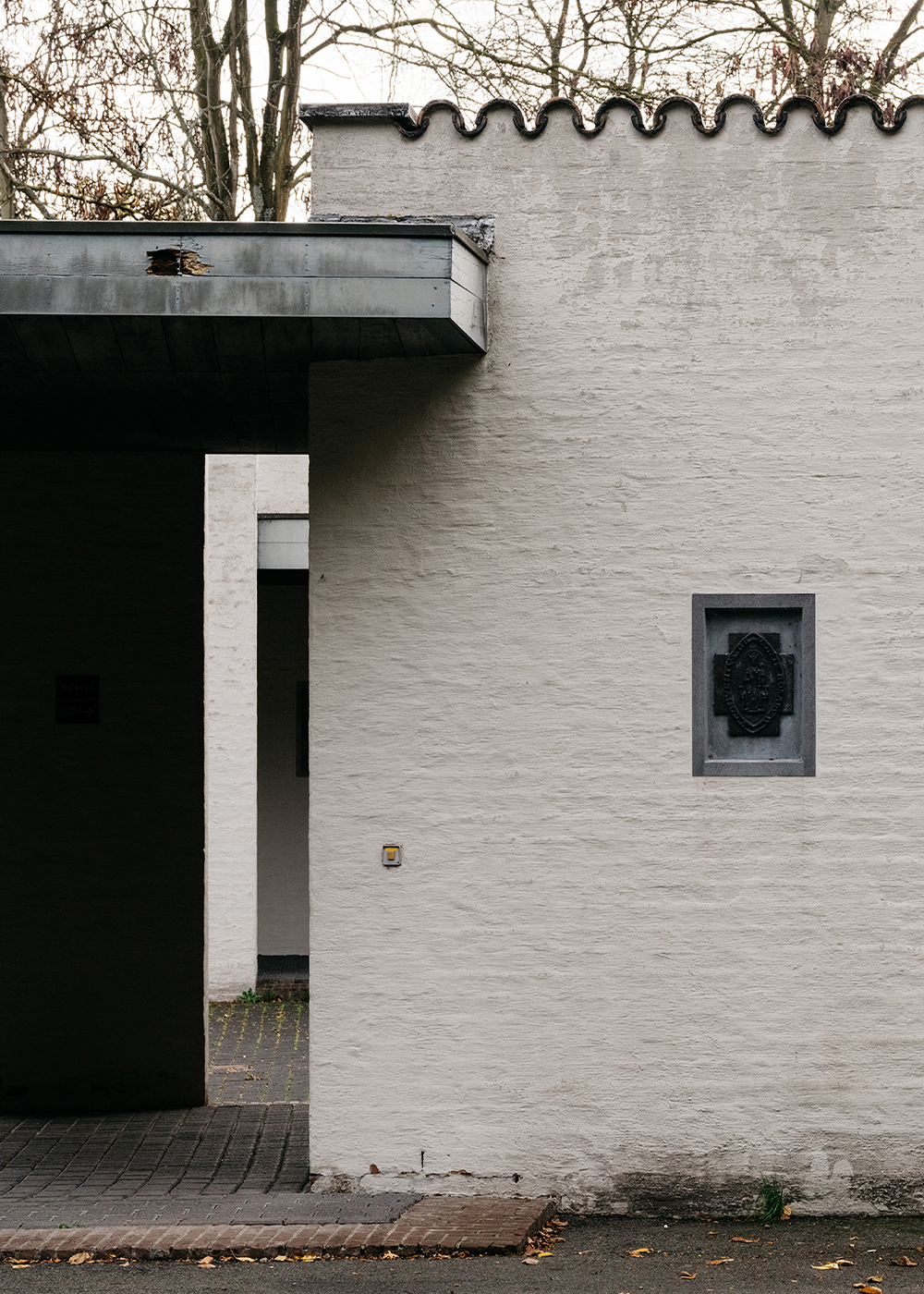
The initial encounter with the abbey is a statement of extreme simplicity. The massive brick walls are uniformly clad in rough, plain white plaster, rejecting any decorative reading. A thin, line-like roof of black glazed clay tiles precisely outlines the form, creating an elemental contrast with the white walls. The long façade, punctuated only by the entrance and a single small window on the distant second floor, exhibits a profound restraint.
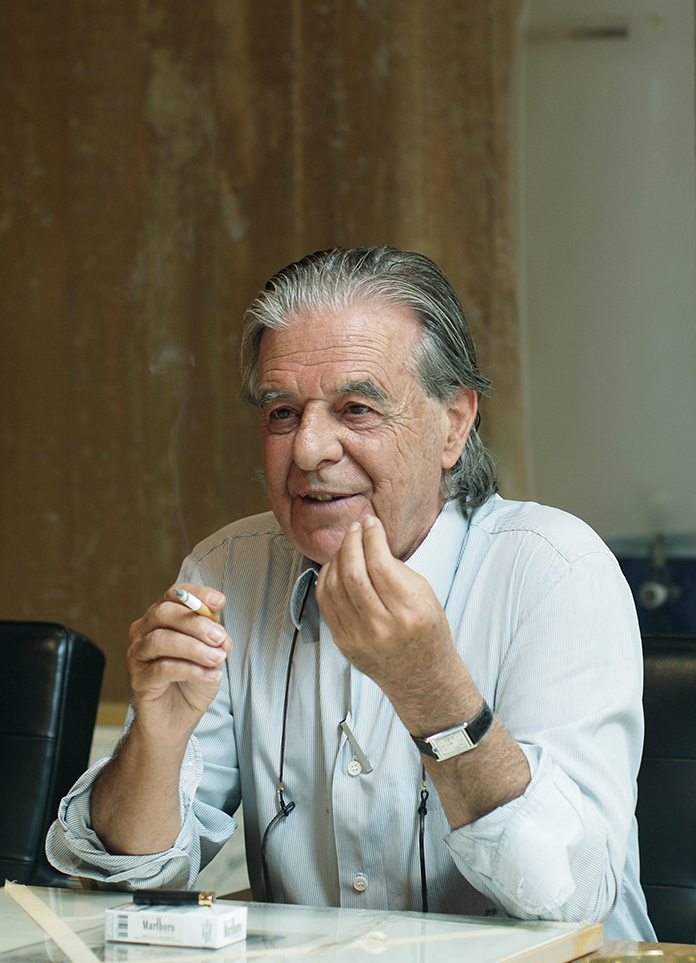
Our guide, Louise Descampe, an architect herself, revealed the starting point here: the architect, Dom Hans van der Laan (1904-1991), was not only a Benedictine monk but also a seeker of spatial order. He developed a unique proportional system called the "Plastic Number," intended to replace the static golden section. Through a series of gradual, harmonious ratios—centered around foundational relationships like 3:4—he sought to create architecture that could be physically perceived and spiritually calming. This silent white wall was the solid foundation of his entire vision, masking the intricately calculated order within.
Passing through the main gate, we did not enter an interior space but stepped into an open forecourt. The space immediately overturned any expectation of a common rectangle, forming a distinctive trapezoidal plane. Through a subtle angular shift, van der Laan rotated two wings in relation to the main body, injecting a hint of dynamic movement into the balanced composition.
The cloister surrounding the courtyard is the first tangible manifestation of the building's rhythm. Sturdy white brick pillars repeat at a rigorous interval. As sunlight slants through, it casts a pattern of deep, regular shadows onto the stone floor. Walking through, one's pace instinctively slows. The dynamic order of the Plastic Number is prefigured in the rhythm of these colonnades. Van der Laan believed architectural order should make one perceive the measure of time, like days, moons, and seasons. Here, each step felt like moving to its quiet beat.
Moving from the open cloister into the interior vestibule, light abruptly receded, and the space softened into a gentle gloom. This was the architect's deliberate visual reset—after the exterior brightness and the cloister's rhythm, the senses were first submerged in a void of "emptiness" and "quiet."
In this dimness, the only light source assumed a sacred, guiding quality. It flowed from the stairwell: light poured from a high window, streaming down the steps, making it a luminous focal point in the dusky hall. The act of ascending—first drawn towards the light, then traveling alongside it—became a ritual transition from darkness to illumination.
On the second floor lay the cells for the sisters and guests. The dimensions here show the most delicate consideration for human dwelling, their length and width often following harmonious ratios derived from the Plastic Number, such as the classic 6:7. Two square windows framed the garden's greenery into a living painting. Every piece of furniture—bed, wardrobe, table, chair—was designed by van der Laan, crafted from native oak to reveal the wood's essential grain. Their form and proportion share the same genesis as the architecture itself. One is enveloped in an absolute harmony from the macro structure to the micro object. Here, there are no mere "items," only the continuation of an architectural logic.
Returning to the ground floor, we passed through a series of functional "half-spaces," such as the refectory and library. One side of these rooms opens into a broad main area, while the other borders a continuous corridor. Van der Laan practiced a refined composition here: the ratio of corridor width to hall width is 2:5. Further, the spacing of the structural piers and the window openings each follow distinct, interwoven rhythms derived from the Plastic Number. As the eye passes over them, it seems to read two layered yet harmonious spatial melodies—complex yet ordered. This is his embodiment of making "space rhyme like poetry."
After moving through this sequenced progression, one finally arrives at the church, the spiritual apex of the architectural journey. Its form is singular: upon a rectangular base stands a pure, vertical octagonal volume.
The altar sits at the center. Light filters from above, illuminating the rough white walls. The overall proportion of the space is strictly governed by the most balanced 3:4 ratio sought by the Plastic Number. There is no symbolic sacredness here, only a sublime silence evoked by absolute proportion, tranquil light, and humble material. It perfectly realizes van der Laan's belief: architecture should integrate space, form, and measure into one, aligning with our inner perception.
Emerging from the silence of the church into the central garden, tightly enclosed by the four wings of the building, the experience completes a cycle—from nature (the forest) to human artifice (the building), and finally to an "architecturalized" nature.
The garden is the ultimate expression of this inward spirit. It is not a landscape painting but an extension of the architecture. A border of neatly trimmed, square shrubs strictly follows the building's outline; on the level lawn, a few trees stand with graceful posture. There are no superfluous curves or colors, only a dialogue between geometry and life. As van der Laan described, it is the hortus conclusus ("enclosed garden") from the Song of Songs—an inward cosmos belonging solely to contemplation.
Looking back at Roosenberg Abbey, it transcends its physical existence to become a "vessel for thought." Through the Plastic Number, van der Laan translated intangible spiritual rhythms into a tangible, tactile order. He demonstrated that true simplicity is not deprivation, but the foundation of depth; that harmonious proportion is a spatial language speaking directly to the soul, perpetually inviting every visitor to embark on an inward exploration.
公开 不公开