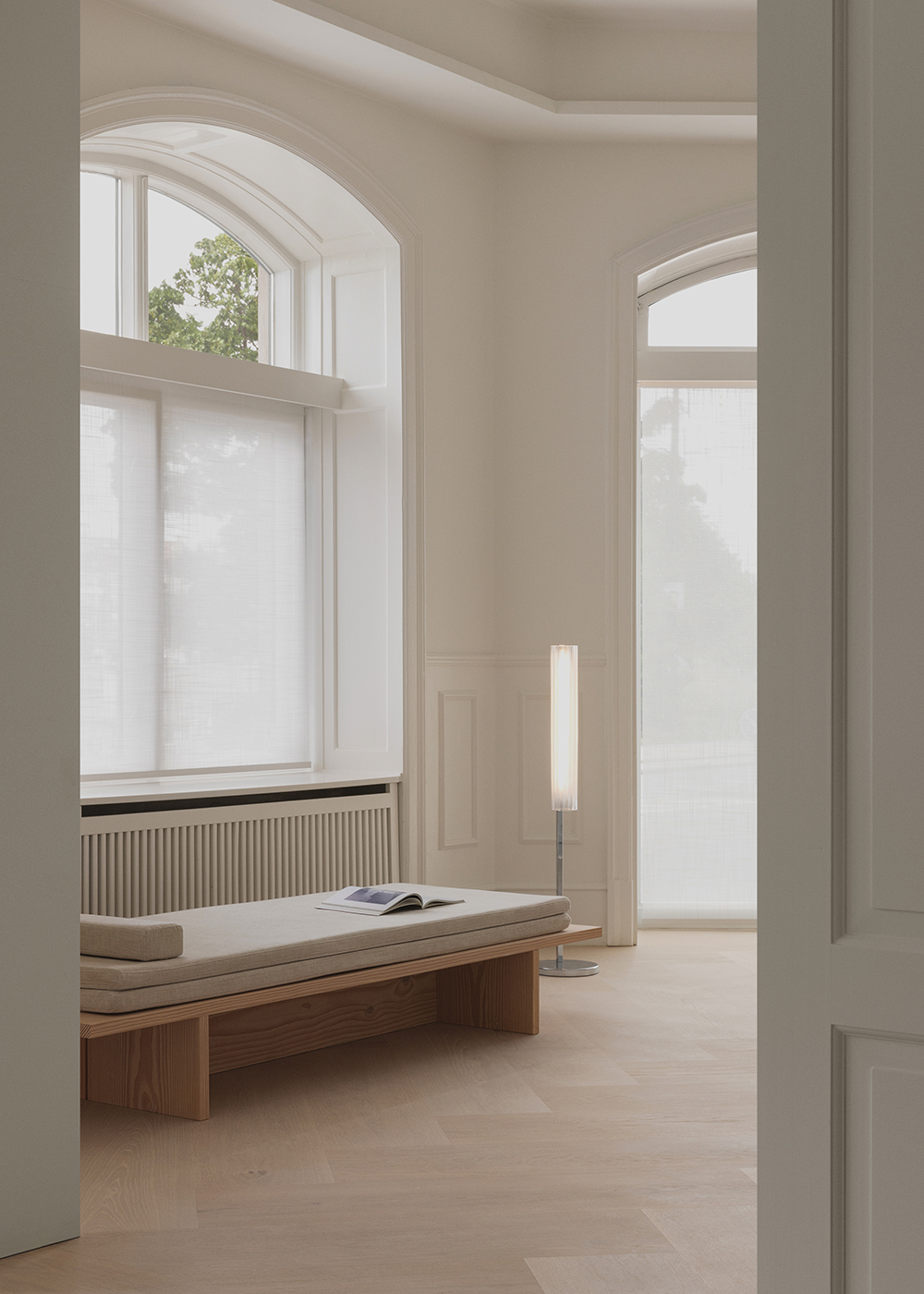
Danish century-old brand Dinesen’s showroom in Copenhagen is tucked away in a historic building dating back to 1875. The classical rhythm of the facade creates a subtle yet perfectly balanced contrast with the near-silent order within. In this tidy and serene apartment-style exhibition space, British minimalist architect John Pawson employs an extremely restrained approach, allowing the material itself to take centre stage. An exploration into the essence of material begins here.

Led by Hans Peter Dinesen, the fifth-generation owner of the brand, we step into this space imbued with a tranquil aura. "The showroom is divided into two parts: on one side is the Dinesen Apartment – a complete apartment space; on the other is the Gallery – a more experimental exhibition space." His words are gentle, much like the space itself – restrained yet full of presence.

"Light, White, Wood." Hans Peter Dinesen uses these three words to encapsulate the core design concept of the apartment space. This is John Pawson’s quintessential spatial language, and also the core philosophy behind the more than three-decade-long collaboration between the brand and John Pawson. "Founded in 1898, Dinesen began as a sawmill serving Danish churches, castles, and historic buildings. The turning point came with the encounter with British architect John Pawson." Hans Peter shares the history of the Dinesen family’s evolution. "My father and John Pawson met in the early 1990s, and a friendly collaboration began from there."
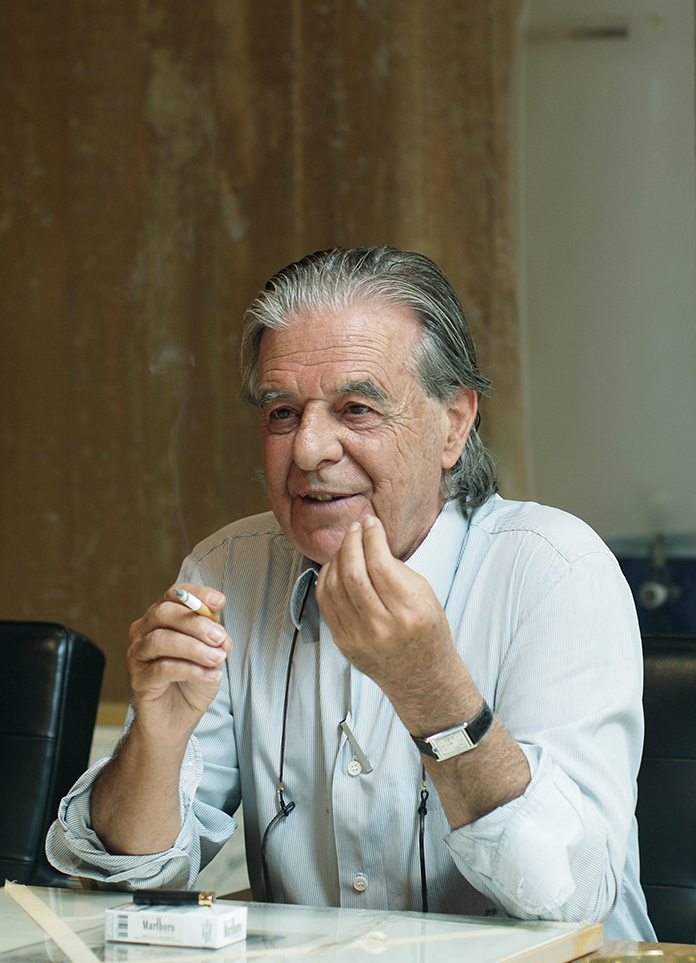
The collaboration started when John Pawson needed a solid wood plank floorboard measuring 15 metres in length for his London residence, extending from the living room through the kitchen and out to the outdoor terrace. Dinesen helped him realise this bold vision. Grounded in a deep understanding and shared affinity for timber, John Pawson used this single plank floorboard as the core inspiration to design three pieces of furniture, commissioning Dinesen to manufacture them. In this mutually resonant exploration, Dinesen gradually expanded the boundaries of timber applications, moving beyond its traditional positioning and allowing wood to truly integrate into spatial structure and atmospheric creation.

This friendship, one that has mutually enhanced both parties, has lasted for decades. To mark its 30th anniversary, Pawson and Dinesen collaborated on the Dinesen Apartment. The apartment comprises a living room, a small study, a library, and a kitchen, forming a complete living space. The interior is simplified as much as possible, with white walls stripped of excessive ornamentation. The 11-metre-long plank flooring softens and blurs the spatial boundaries.

The furniture collection, recreated based on the original 1992 Pawson House series, retains the minimalist form of solid wood – understated and restrained, yet imbued with gentleness and texture. Walking through the apartment, one feels the light slowly spreading across the wooden floors and walls. The breath of the timber is amplified, and human perception is reawakened: the footsteps, the textures, the play of light become the most significant elements of the space.

In contrast to the restraint of the apartment, the "Gallery" presents more experiments with materials: timbers of different species, scales, and surface treatments are brought together in one space, offering a direct display of wood’s possibilities. During the annual 3 Days of Design festival in Denmark, the exhibition here is refreshed. The current exhibit is the result of a collaboration between Dinesen and the Royal Danish Academy – School of Architecture.

Hans Peter points to the architectural models and photographs on display: "We invite students to our headquarters to learn about timber construction, to design and build actual small-scale structures – fishing huts, saunas, artist residencies. Some projects can be completed in just two weeks." The brand provides the land, materials, and funding, allowing young architects to understand the properties of wood through hands-on construction. In his view, this is not charity, but a cultivation of the industry: "We depend on architects. The architects of tomorrow are the clients of tomorrow."

As the visit deepens, the discussion gradually shifts from the space to the material itself. The participants continuously pose questions about timber applications and construction – from the structural stability of extra-long planks, to humidity control in different climates, to the compatibility of wooden flooring with underfloor heating – with the conversation unfolding in a relaxed yet focused atmosphere.

Hans Peter believes the key lies not in the material itself, but in how the architecture adapts to the material. He emphasises: "What matters is that the architecture needs to adapt to the floor, not that the floor needs to adapt to the architecture." Participants from diverse backgrounds share experiences from their own projects, extending the questions to increasingly complex architectural scenarios. The material is no longer simply an object of explanation, but becomes a medium for exchange.

From the serene tranquility of one space to the ongoing exploration of the other, through this walk and the conversations within, we genuinely experience the way of life that Dinesen pursues – where timber is truly integrated into architecture, and into our daily lives. Standing within this quiet space, enveloped by light and wood, we come to understand what Dinesen’s brand宣言 means when it says, "Wood is a living material." The craftsmanship they uphold is not merely a skill, but a profound respect for the material itself.

MORE PHOTOS