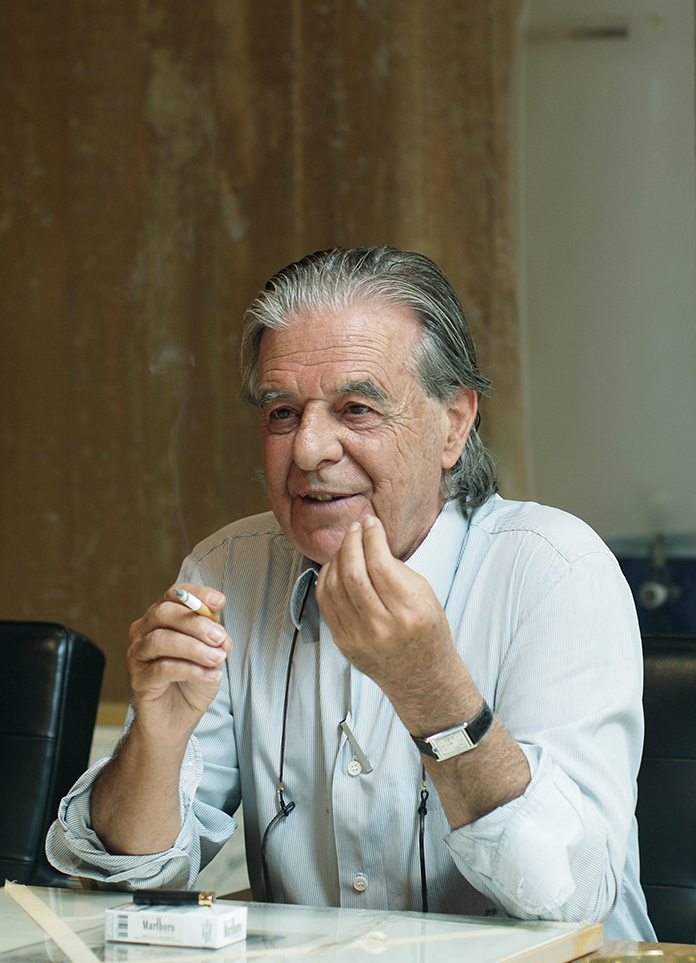
Pushing open the door to a quiet factory building in Antwerp feels like stepping into a silent dialogue—a profound counterpoint between undercurrent and stardust, inner gazing and distant vistas, feminine intuition and masculine alchemy. Here reside two artists of contrasting temperaments yet intertwined souls: Ileana Moro and Marius Ritiu. Their studio is not merely an overlap of physical spaces but a crossroads of spiritual geographies, an ongoing, deep conversation of creation.

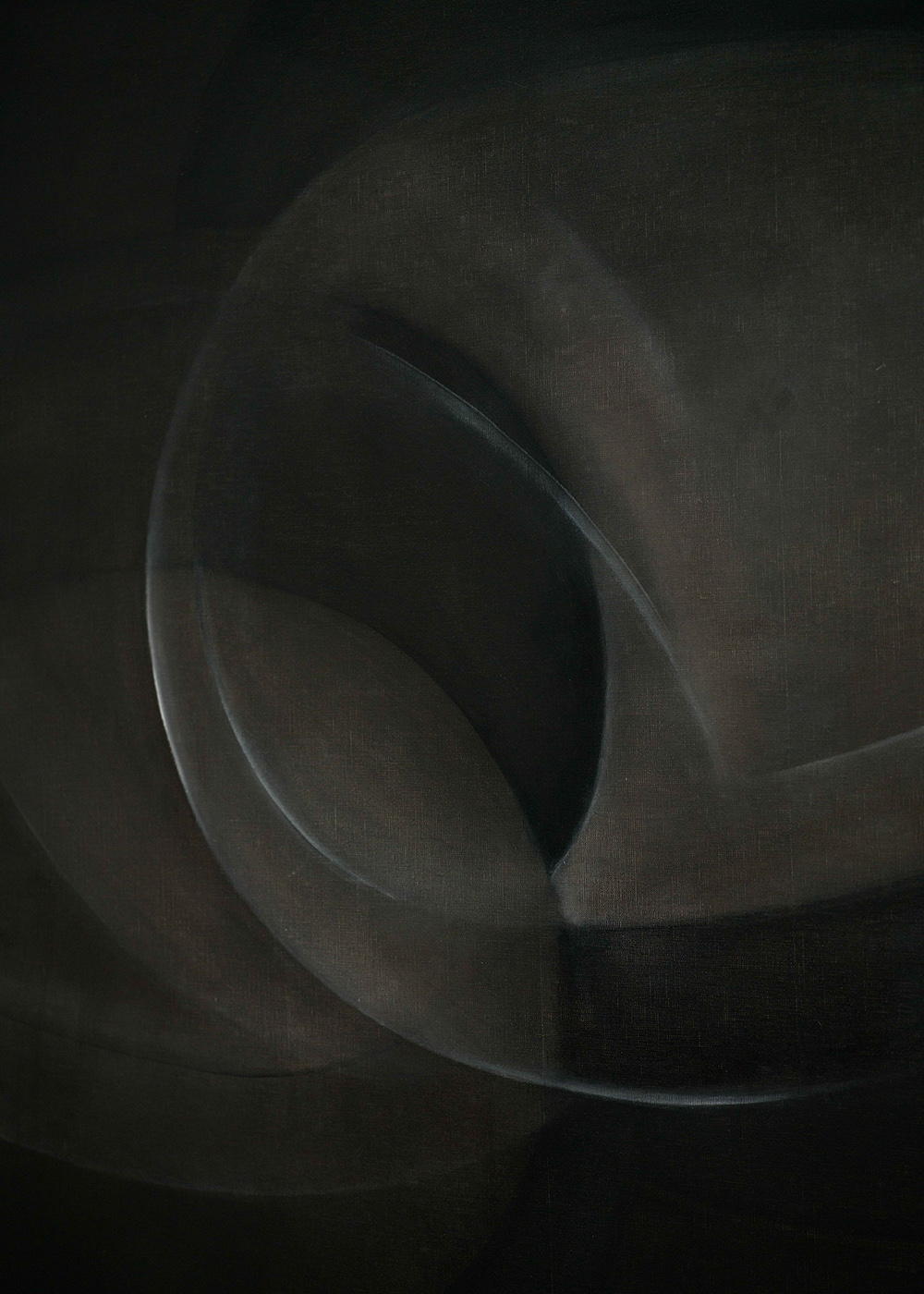
Entering Ileana's space, the senses are first enveloped by a calibrated "darkness." Tall white walls form the backdrop for a series of profound black canvases—not a void, but a mysterious black harboring infinite depth. Light slants down from above, casting subtle gradients of halation on the canvas surface, as if night itself were unfurled into a handscroll meant for slow contemplation. Her black is never an end, but a beginning. 

"Blossoms I Can No Longer Touch" hangs on the wall. The nearly monochromatic expanse initially appears as a domain of pure black. Yet, sustained gazing reveals a hazy play of light and shadow emerging from the depths—the ghostly form of a flower, a vestige of memory. "I am from Costa Rica," Ileana's voice is soft yet resolute, "This painting is about distance, about things that can no longer be reached, geographically or in time." Here, black is no longer absence but becomes a negative space that holds memory, nostalgia, and spiritual presence.

Formally trained in architecture, she treats the canvas as an inhabitable field, her brushstrokes akin to walking trajectories through space. The recurring cloak-like forms, described as beings - whether human or otherwise, wrapped in melancholy blue veils, symbolize an inward journey. "It is a shelter, and also a revelation," she explains, "The veil simultaneously conceals and reveals the inner life." Like the thresholds between figuration and abstraction in her work, the viewer is invited to stand at this edge and gaze inward. Before the large-scale work Shifting Perspective, the viewer's physical movement completes the piece. The central, blurred human form distorts with the shifting viewpoint, a silent narration on the fluidity of identity. Ileana's work offers no answers, only entrances. Her handling of light carries an oracular quality, like a stray beam in an ancient sanctuary—not meant to illuminate everything, but to guide the gaze.
Passing through the wide opening, the atmosphere shifts palpably. If Ileana's space is meditative and absorptive, Marius's domain is forge-like and radiant. The air carries the scent of metal and fire, and the eye meets the texture of copper everywhere—not the smooth finish of industry, but a skin imprinted with geological memory after countless hammer blows.

Marius's practice is built on a nomadic existence. His Repoussé technique is an art of migration itself—requiring only a hammer, a stake, and fire, he can transform a copper sheet into a narrative surface anywhere. "Copper is the material that connects the world," he says, lifting a fragment shimmering with blue-green patina. "In ancient alchemy, it corresponded to Venus; today, it flows through global networks of communication and energy. I am hammering not just metal, but this very connectivity."

The "Overview Effect" deeply shapes his vision. The astronauts' life-altering realization upon seeing Earth from space—that "all borders are illusory"—forms the core metaphor of his work. His copper sculptures resemble an act of interstellar archaeology: these forms, replicating the texture of meteorites, pitted and folded, are not mere imitations of nature but materializations of this cosmic perspective. In an installation at New York's Socrates Sculpture Park, he placed a hand-hammered "meteorite" inside an ordinary supermarket cart, creating a poignant juxtaposition—the eternal scale of the cosmos colliding with transient consumer culture, inviting viewers to re-examine their place in space and time.

"I am not making rocks; I am making space itself," Marius defines his work. He hammers copper sheets against stones gathered worldwide, imprinting the earth's skeleton, then reassembles them into seemingly extraterrestrial forms. This practice transcends ordinary sculpture, becoming a humble cosmological inquiry: how humans, through manual labor and material transformation, might comprehend their existence within the vastness of time and space, and perceive the profound connection that dissolves all boundaries.

The artists' relationship extends beyond aesthetic complementarity; it is like two distinct energies resonating in harmony within a single field. Ileana's dark-toned canvases and Marius's coppery glow are the poles of light and shadow; her inward intuition and his outward exploration weave a more complete perceptual tapestry; her philosophy of "becoming like water" and his nomadic existence engage in a sustained and subtle symbiosis. Their shared space gives tangible form to this difference and interweaving. Ileana's area maintains the purity and serenity of a white box, paintings arranged on the wall like silent verse, establishing an atmosphere of profound introspection. Just steps away lies Marius's realm, reminiscent of a medieval workshop—tools and unfinished works openly displayed, the traces of hammering and the scent of metal in the air, emphasizing the vitality of the process itself. These adjacent domains are like two celestial bodies in independent orbits, sharing the same creative cosmos.

This difference translates into profound creative tension in daily life. The figures in Ileana's paintings, lovers gently removing masks, explore vulnerable unveiling in intimacy. Meanwhile, Marius's venture into objects that blur sculpture and furniture (like functional benches) stems from the shift in perspective Ileana inspired. "She made me see that between art and design there is no wall, but an open field one can freely traverse," he says. Their perspectives permeate each other, quietly expanding their creative boundaries.

A more fundamental resonance lies in their shared distance from certainty and embrace of openness. Ileana insists on the "unfinished," viewing the canvas as an invitation, not a statement; Marius calls himself a "storyteller" yet deliberately leaves narrative blanks. Their studio thus transcends the mere workplace, becoming a living field perpetually in a state of "becoming." Here, difference nourishes dialogue; boundaries become frontiers of encounter. Perhaps this is the space's most moving revelation: it witnesses how two independent creative lives, while maintaining their pure selves, through daily companionship and spiritual dialogue, ultimately weave themselves into one rich star trail—each shining, and thus illuminating the other. 

Upon leaving, the morning sunlight passing through the opening gilds the edges of Ileana's black canvases while awakening slumbering light deep within Marius's copper sculptures. In that moment, two worlds fuse within a single beam. This visit transcended appreciating individual works. It reminds us that the finest creation springs from the courage to inhabit boundaries, and from a serene belief: in light within darkness, in the infinite imagined within the finite, in the equilibrium between diving deep into the self and gazing far into the world. 

MORE PHOTOS