At the southernmost tip of Bali, the limestone cliffs of Uluwatu carve rugged lines against the Indian Ocean's azure expanse. This land, whose name translates to "the rock at the land's end," is renowned for its world-class surf spots and ancient temples, but it also cradles a modern architectural statement: Villa 318 Uluwatu House.
Conceived by the SAOTA studio, this resort‐inspired home does not dominate the cliffside. Instead, it assumes a humble, contemporary presence, settling into the dramatic landscape like a stone shaped by time, its form gradually blending into the legendary scenery.
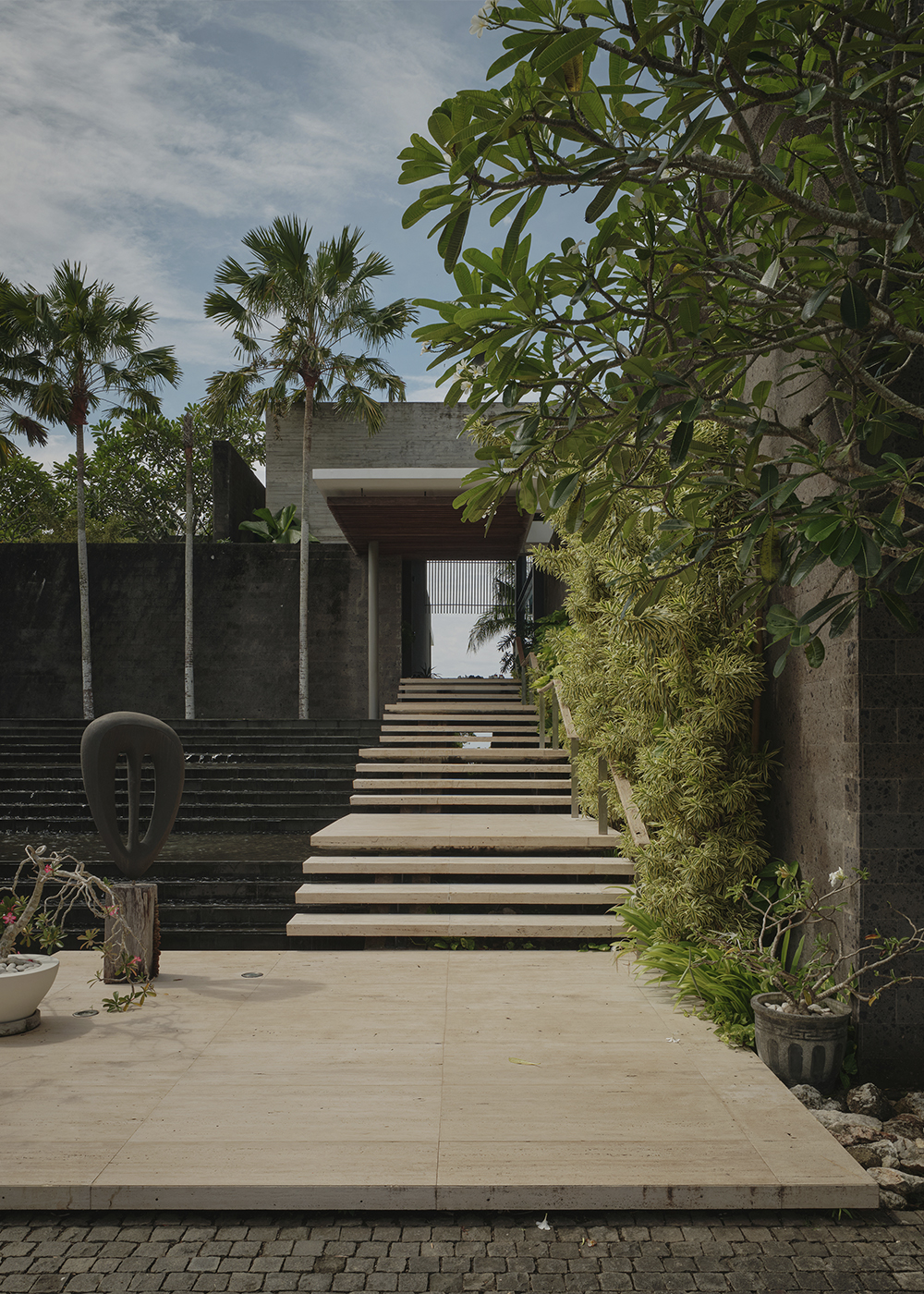
A serene arrival court, shaded by local foliage, gives way to a poised stone staircase suspended above shallow, tiered pools. A monolithic wall of local black volcanic stone lines one side. Solid and textural, its surface takes on a deep, resonant hue under the tropical sun. This wall appears to emerge from the earth itself, setting a foundational tone of modern respect for local materiality. Ascending the steps to the sound of trickling water, a quiet sense of ceremony unfolds.
Beyond the entrance, the architectural heart is revealed. Drawing from traditional Balinese principles, the design masterfully balances mass and lightness. Its most commanding feature is the reinterpreted, monumental concrete pitched roof.
In the main living pavilion, the archetypal wooden bale structure is transformed. A concrete pitched roof, imprinted with the grain of its timber formwork, appears to float where a lightweight roof would traditionally be. This roof is the project's central architectural statement. It functions not just as shelter, but as a sculpture suspended between sky, cloud, and sea. Its precise pitch is a calculated response to the orientation, framing the morning light and sea views while providing shelter from the western sun.
Beneath this vast canopy, space is liberated. Dining, living, and bar areas are defined by full-height glazing, framing uninterrupted ocean vistas. Bright, airy furniture in shades of blue, white, and grey, with clean-lined profiles, contrasts elegantly with the roof's solidity, together creating an atmosphere of serene grandeur.
The design's core philosophy lies in dissolving boundaries. The plan follows a fragmented, resort-style layout, where independent suites and living pavilions are arranged like islands amid a "sea" of courtyards, gardens, and terraces.
Movement becomes a sequence of curated scenes: from shaded interiors to sun-dappled courtyards, through passages into secluded gardens. The absence of internal corridors makes every transition a direct engagement with nature and light.
This fluidity culminates at the infinity pool. A turquoise plane extends from the building's edge, its rim seamlessly aligning with the horizon of the Indian Ocean. The pool and sea merge visually, creating an unbounded, azure canvas.
Flanking the main pavilion are quiet guest suites, each a private retreat with an ocean-facing balcony. To the east, the master suite unfolds as a poetic sequence. Interlinked study, lounge, bedroom, and bathroom are cleverly separated by walls, forming a fluid, private journey.
Here, the bathroom is conceived as a sensory ritual. A sunken bathtub is centered within a shallow interior pool, establishing a meditative focus. This rectangular water feature passes beneath the glazing to extend calmly into the open-air shower, unifying interior and exterior through a continuous plane of water. Light filters through wooden screens, casting dynamic patterns on stone and water—a space for bathing that feels intimately connected to the elements.
The architecture ultimately serves as a frame for nature. Descending from the private terrace, one reaches a viewing pavilion cantilevered at the cliff's edge. Here, architecture recedes. The constant rhythm of Uluwatu's waves provides the soundtrack. The view is an unobstructed, majestic seascape: sparkling blue meeting white spray on the reefs below. Time seems measured by the tide.
The design's intelligence is fully revealed. It does not compete with the landscape but constructs a refined, modern vantage point. Every material—the rugged stone, textured concrete, refined woodwork—serves to facilitate a deeper, more profound immersion into Bali's raw natural power.
Departing at noon under the intense sun, a final glance back reframes Villa 318. It no longer reads as a mere impressive house, but more as a warm, solid form nestled against the cliff, its horizontal lines in quiet dialogue with the vertical drop. It achieves its initial vision: a dwelling that feels destined, over time, to be gently reclaimed by the landscape it so respectfully inhabits. This may be the true essence of a transcendent retreat—it offers supreme comfort and aesthetics, yet ultimately defers, ensuring the lasting memory is not of the building, but of the boundless sea.
公开 不公开