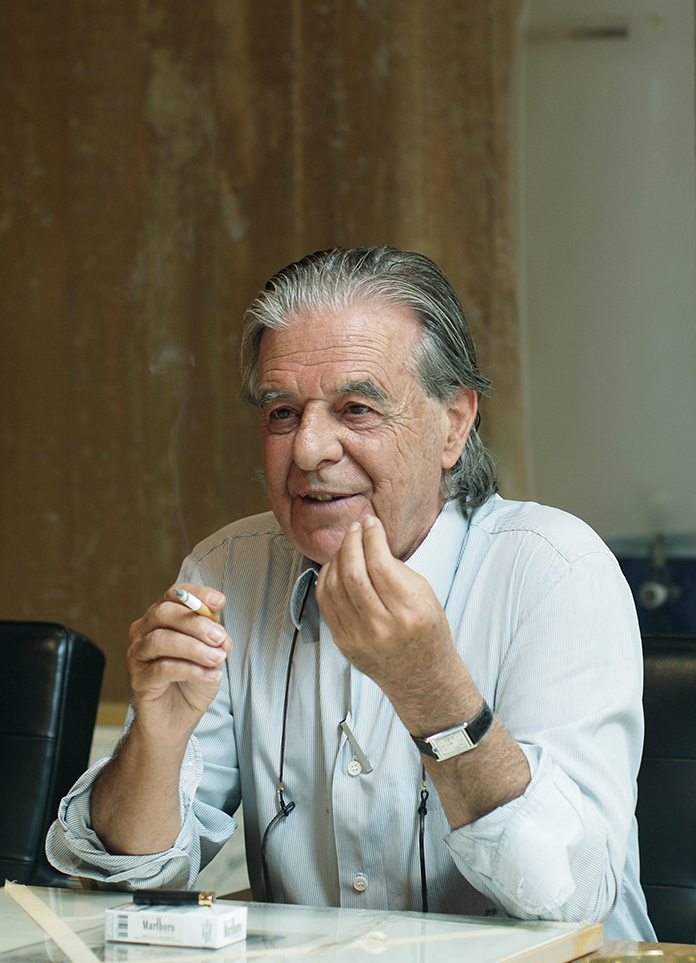
One of the most anticipated stops of this journey through Belgium was VVD II Residence in Antwerp — the private home of Vincent Van Duysen. A master who has transformed his sensitive temperament into a language of warm minimalism, Van Duysen has created here a quiet and restrained dwelling. It not only holds the order of daily life, but also feels like a refuge that leaves space for the spirit, offering a sense of calm and stillness as life returns to its essence.
As we drove into Antwerp, the view outside the window was still made up of ordinary city scenes — supermarkets, gas stations, passing cars, nothing unusual at all. But as we went further, the atmosphere of the neighborhood began to shift. Once we turned into a Victorian residential area, everything suddenly became much quieter, as if we had moved from the everyday rhythm of the city into a different pace altogether. In front of us stood a nineteenth-century townhouse with an unusually wide façade. Compared to the narrow, vertical street houses so common in Belgium, it felt especially calm and immediately drew our attention.
Vincent was already standing at the door waiting for us. Dressed simply in a navy sweater and dark jeans, he looked calm, with a natural smile that felt more like he was waiting for old friends than receiving visitors. It was hard to imagine that only a few hours later, he would be flying to Milan. Standing face to face with him, it felt natural to sense that the way he moves through life is not unlike the way he shapes space — quiet, restrained, yet always warm. Before thinking of him as an architect, what came through first was simply the seriousness and care with which he lives. It is perhaps from this kind of everyday attentiveness that those calm and comforting spaces slowly take shape.
In the midst of conversation, Vincent introduced the three studio members accompanying him: studio partner and COO, Kristof Geldmeyer, along with two assistants. The visit began naturally through this easy exchange. Speaking about the house, Vincent’s tone was calm: “This house is very special to me. I have lived here for 25 years.” For him, it is not only a refuge, but also a place that holds his long-standing understanding of life and design. “Although I also have another house in Portugal, this one has always carried a different meaning.”
When Vincent took over the house in 1999, most traces of its former life had already disappeared. Faced with a home whose origins could be traced back to the seventeenth century, he spent the first year planning and rethinking the relationship between light, proportion, and the way a person moves through space. “The most important thing in design is the balance between space and proportion,” he said, gently but with great clarity. Over the following two years, he stripped the house back almost entirely to its structure, working consistently around ideas of essence, abstraction, and purity. In doing so, he brought together a pared-back formal language and an unpretentious sense of everyday life, shaping the house into what it feels like now: quiet, restrained, and full of a grounded beauty.
Passing through the quiet, square entrance hall, we followed Vincent into the living room. This was a space that had already been spoken about many times, yet the feeling of actually stepping into it was entirely different. With its open dimensions of around 10 by 11 metres, the room makes you pause, if only for a moment. And yet it never feels empty because of its size; instead, it holds a very natural sense of calm. To make the space better suited to everyday living, Vincent chose not to use a centrally symmetrical layout. Instead, he placed the sitting area beside the fireplace, bringing that corner closer to the rhythms of daily life, while a long table at the centre accommodates work, meals, and gatherings, allowing different parts of life to unfold within the same space.
At the heart of the house is an internal courtyard lit from above. A Japanese maple stands quietly at its centre, while the industrial metal frame filters light and greenery before letting them fall gently into the living room, entrance hall, and kitchen. In this way, daylight enters the house naturally, and the interior seems to breathe in rhythm with the outside. Facing the group, Vincent spoke in a calm yet assured voice: “What matters most is the balance between space and proportion — creating a connection between the interior and its surroundings, and bringing nature into the home.”
What we felt here was not the distance of a legendary figure, but rather an atmosphere that was thoughtful, relaxed, and quietly welcoming. “I have three dogs,” Vincent said with a smile as he led us further inside. “They always like to leave traces on the carpet, so please excuse that.” Somehow, this small remark made the house feel even more real, and closer to everyday life. Vincent shared the details of the home with complete openness, even pulling open the concealed bookshelf in the living room himself: “When I want things to feel tidy, I close it. When I want the space to feel a little more lively, I open it and let the books become part of the room.”
The kitchen, bathroom, and even his vast collection of books are all quietly tucked behind a continuous wall of panels, giving the space a deep sense of calm. Against this restrained backdrop, Vincent’s collection of vintage furniture, contemporary ceramics, and artworks naturally comes forward, each piece speaking in a quiet but distinct way. It is also here that his enduring spatial philosophy becomes especially clear: architecture, interiors, and objects are never separate elements, but parts of a whole that must always be considered together.
The staircase leading to the upper floor has been fully preserved, and each step still carries a deep, resonant sound. On the second floor, the main bedroom was created from what used to be the old living room, retaining a sense of openness and receiving generous natural light. In contrast, a charcoal-toned TV room feels far more inward and private.
The real surprise, though, was the attic on the top floor. Once the old partition walls were removed, the original seventeenth-century timber structure was revealed in full, opening up the space completely. Vincent turned it into an open loft suite, with reclaimed old wood laid across the floor and a north-facing window framing the church spires of the city beyond. The functional elements are still tucked behind wall panels, but the atmosphere here feels noticeably different — warmer, softer, and held together by the comfort of wood.
Vincent often says that he is a sensitive person, and in his home that sensitivity never feels abstract. It comes through slowly in the materials, the light, and the way surfaces meet the hand. Beneath the fingertips, there is the warmth of reclaimed timber flooring, the coolness of Belgian bluestone, and the fine grain of Italian plaster walls. Walking through the house with Vincent, you can clearly feel that what is often described as “warm minimalism” did not begin as a theory imposed on space. It seems to have grown, little by little, out of the way he actually lives.
By this point, we began to understand why Vincent has always resisted being simply defined through the label of “minimalism.” As early as the turn of the century, while much of design was still chasing new forms and shifting styles, he had already turned his attention back to the essence of dwelling itself, asking what could truly endure over time. Perhaps that is why this house still feels so convincing today, and why it continues to resonate so strongly in the present. Vincent has never seemed interested in trends. What matters to him are the more essential and lasting parts of life — how to create a refuge that can truly hold everyday living, and grow deeper with time.
公开 不公开