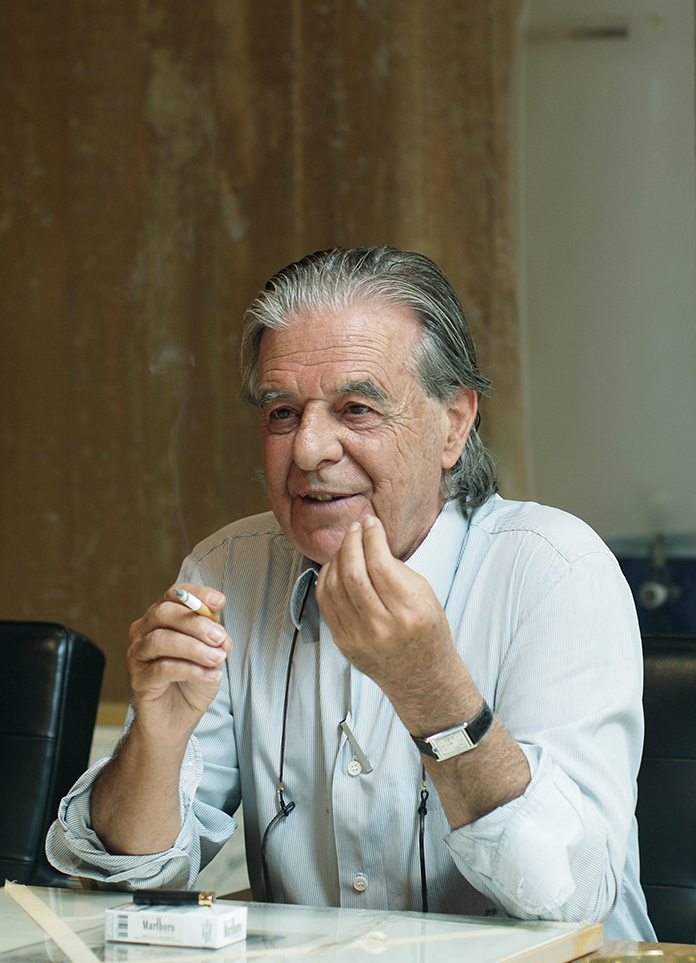
“We take ‘garden exploration’ as our starting point, embedding classical spirit into the sequence of modern spaces. This is not a mere reproduction of a historical academy but a redefinition of spirit: to provide a sanctuary for contemporary life, blending literary essence with gardenscape charm. This is the essence of ‘Garden Reverie, Beijing Dream’.”— YU Zhao , Founder of YU STUDIO.

In the Haidian district of Beijing, near Gongde Temple lies Nation Confidence Project , adjacent to the Summer Palace and facing the Western Hills. Here, the charm of the royal gardens meets Haidian's rich academic heritage. YU STUDIO responds to this unique spiritual ambiance by creating a contemporary academy intertwined with gardens, encouraging a return to a spiritual sanctuary away from materialism. The fusion of “academy” and “garden” creates a scene of “garden exploration in Beijing.” “Jing” signifies Haidian, while “Meng” represents the academy's vision. The space centers around a courtyard, creating a narrative of entry, exploration, and the academy—three distinct episodes within the garden.

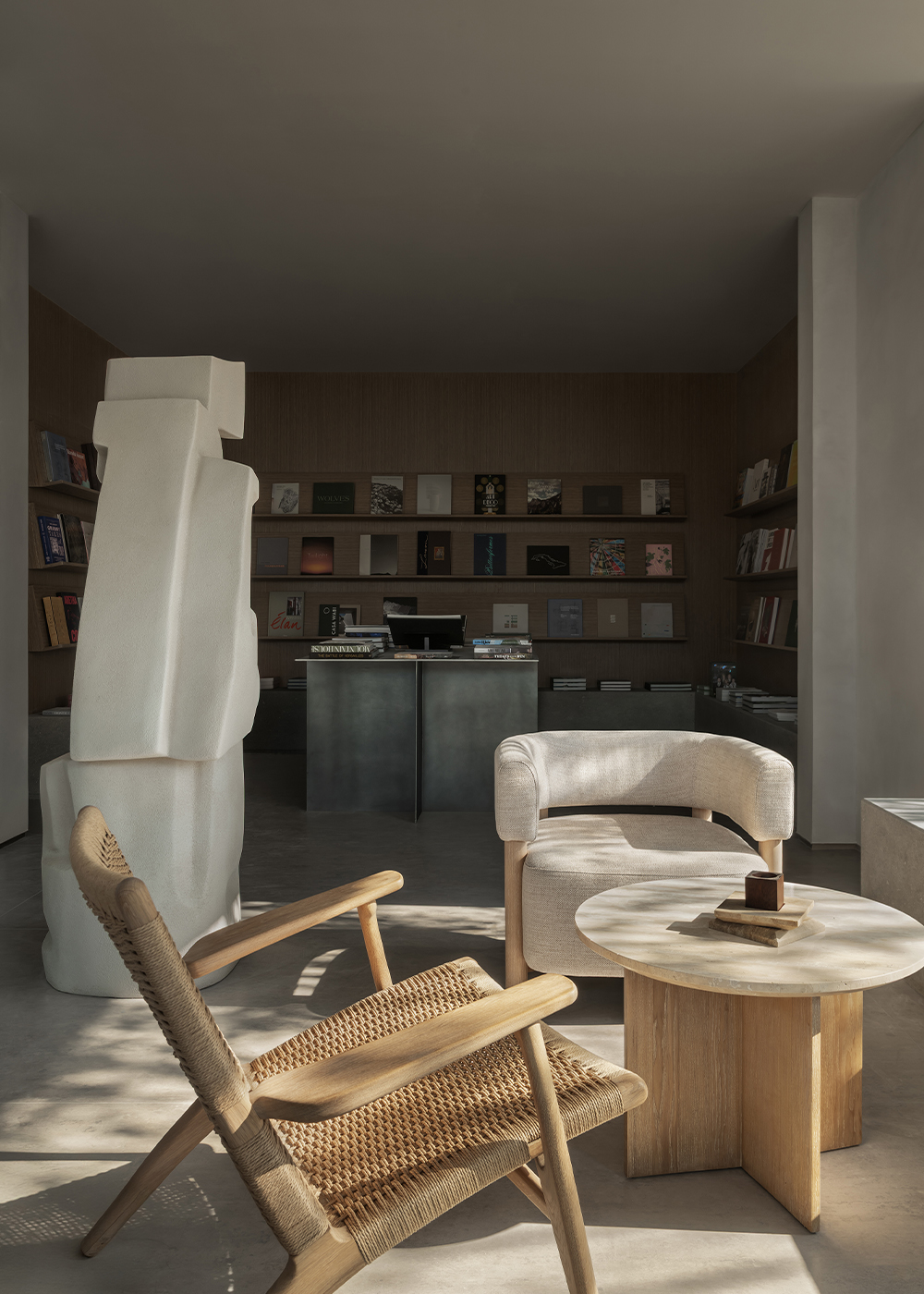
The beginning of Nation Confidence Project is unexpectedly delightful—a corner bookstore. In Haidian, where the fragrance of books permeates and academic institutions abound, the bookstore is more than a place for buying books—it embodies a way of life. The entrance to the project draws upon this sentiment, creating a spiritual realm. The tight street reveals a minimalist façade, while the modern interior invites exploration. Books are openly displayed on tables and walls, creating an inviting atmosphere. The bookstore is positioned for aesthetics, also evoking a sense of everyday warmth; after a long day, one may turn the corner, enter, browse a few pages, and step back into the illuminated street as dusk settles. This feeling inspires the project, culminating in a revelation—within the bookstore lies an academy.
Stepping from the underground drop-off hall, the external noise suddenly fades away, and the space sinks into a profound tranquility. At the entrance, light is deliberately subdued, leaving only a few square lamps glowing softly on the stone floor. A small beast sculpture stands guard at one side, watching over this realm. The view is gently enclosed by delicate mesh screens on both sides, resembling the dreamy curtain of a stage, subtly guiding one toward the light. At this moment, only a dark path unfolds before us—this is a deliberate “obstruction,” serving as a subtle prelude. This is the logic of Chinese gardens: first the restraint, then the revelation, a winding path leading to tranquility.

A magnificent floral art installation, “Spring at the Summer Palace,” suddenly appears—willows like silk and early cherry blossoms in bloom, seemingly transporting one to the shores of Kunming Lake at the Summer Palace: the lake breeze brushes past, and spring water stirs. Yet the garden remains hidden, this is merely the first surprise. Turning forward, deep within the corridor, a horse stands gazing back. This is the work of sculptor Xiang Jing, titled “Will the World Be Alright?” The horse’s gaze is tranquil and profound, silent yet compelling one to pause and behold. The heart, too, finds stillness. Further ahead, as if traversing a corridor, each step reveals a new scene. The art corridor continues the theme of “concealment”—the view is guided to glimpse fragments of the courtyard and paintings from various angles. Scenes within scenes, as the visuals unfold gradually.

Passing the screens, one finally encounters the garden. The social area faces the sunken courtyard, cleverly concealed behind shadow walls, revealing its true form only here. This marks the beginning of “meeting the garden”—the side view unfolds gracefully with the teahouse and social area, serving as the prologue, the introduction, a glimpse before the main act.The semi-open teahouse stands quietly in a corner, the view is meticulously framed, allowing one to gaze at the courtyard from defined angles.

The social area and the bar have a different rhythm—the comfortable enclosure enhances relaxation. Also, the artistic expression of lifestyle further evolves here. Nature-inspired handmade sculpture resonates at the core of the area, opposite the bar. The Bocci pendant light dances above the bar, its spheres leap like pearls, light and natural. Silk carpets, clean-lined furniture, expressive paintings, and greenery gently envelop the space.

Turning to another, more intimate teahouse, the space draws from the garden's winding paths, using curtains, plant landscaping, and other elements to create a layered, progressive, and natural atmosphere.The contemporary ink art piece Between the Curtains by Xu Lei, straddling the line between reality and dreams. The Italian design Davide Groppi’s pendant light delicately illuminates the tea table above, perfectly lighting that cup of tea, as well as that moment of mindfulness and contemplation.

The towering book walls of the library establish the ambiance. The renowned calligrapher XU Jing’s work hangs on the center of the library. “Pillow stone, rinsing in the stream” derives from Records of the Three Kingdoms, suggesting a retreat into the mountains and transcending the mundane. The character “pillow” stands expansive and freedom; “stone” is constraining—within the book is a painting, and within the painting is a book, creating a magnificent momentum between openness and closure.

On the other side, chairs and displays from the Japanese brand Time & Style evoke the charm of ancient writing desks—though the brush and ink are absent, the essence remains. The reading desk and sofa area provide different experiences: quiet immersion at the desk and relaxed socializing, where thoughts collide on the sofa.

The sequential spaces cater to diverse needs. The skylight art studio and handicraft area create new possibilities for life; children sit in the study room while toddlers play nearby. From the youngest to adolescents, all can enjoy quiet reading and creative sharing—The Academy unfolds layer by layer, embracing every aspect of community life.

MORE PHOTOS