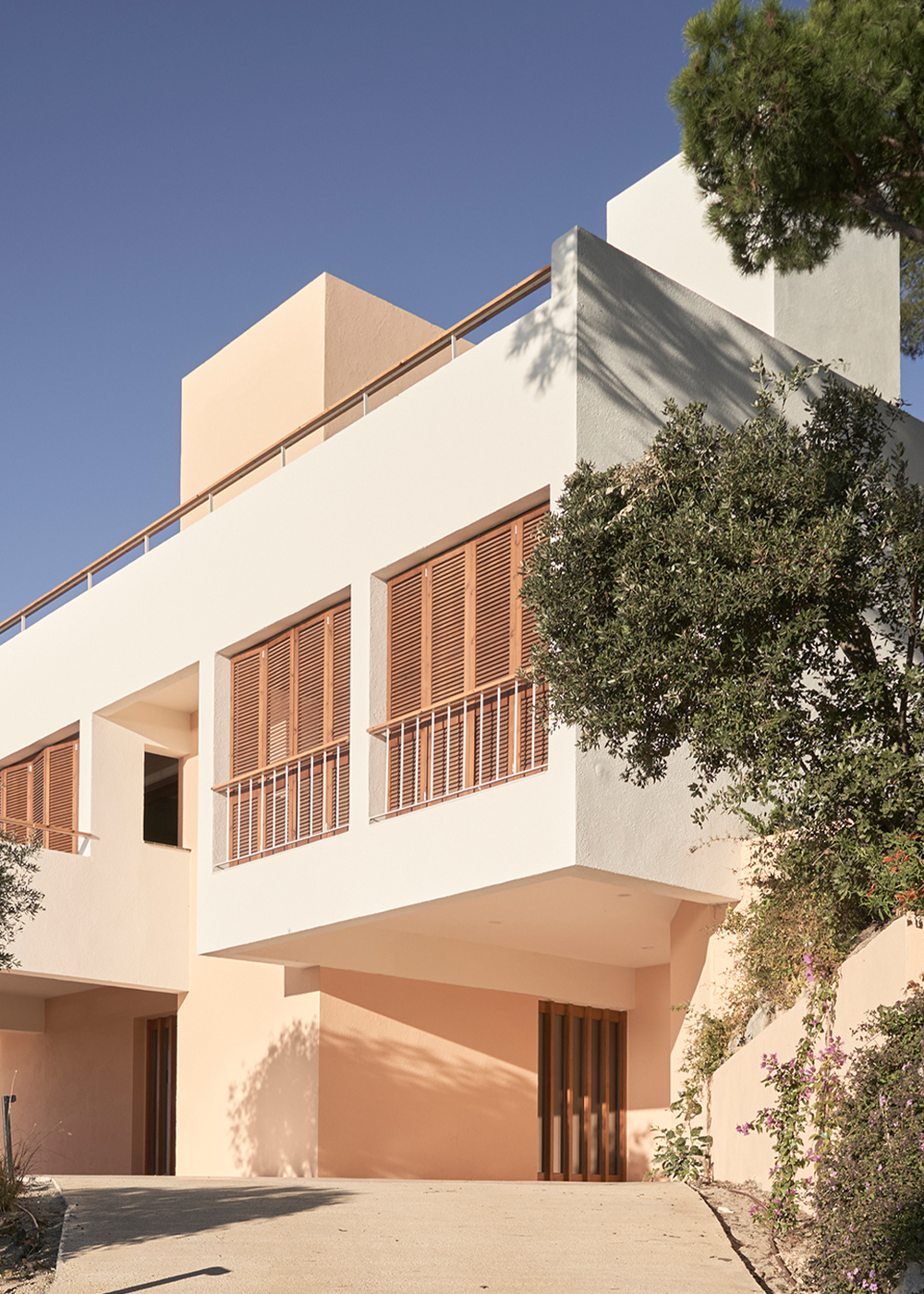
In Premià de Dalt, the intervention begins from a careful recognition of Casa Blajot as a significant late work by Josep Lluís Sert, developed in close dialogue with its client, Josep Blajot. More than a domestic artifact, the house embodies a precise architectural idea: an austere yet spatially generous architecture, deeply rooted in the site, open to the Mediterranean landscape, and shaped through a measured balance between abstraction, climate, structure, and everyday life. The project is therefore not conceived as a reinterpretation from the outside, but as a continuation of that original architectural thought.
The historical study reveals the extent to which the house was defined by Sert’s own principles: a compact volume carefully positioned on a steep site to secure distant views of the sea; a clearly hierarchical relationship between the open southern façade and the more closed, introspective rear side; the use of patios, porches, shutters, and intermediate spaces as environmental and spatial filters; and a geometric discipline that gives the main elevation its abstract and almost monumental character. The house also reflects a highly specific domestic program, shaped by accessibility, broad circulation, and the client’s intense family and social life. These qualities are not secondary attributes, but the very foundation of the project.