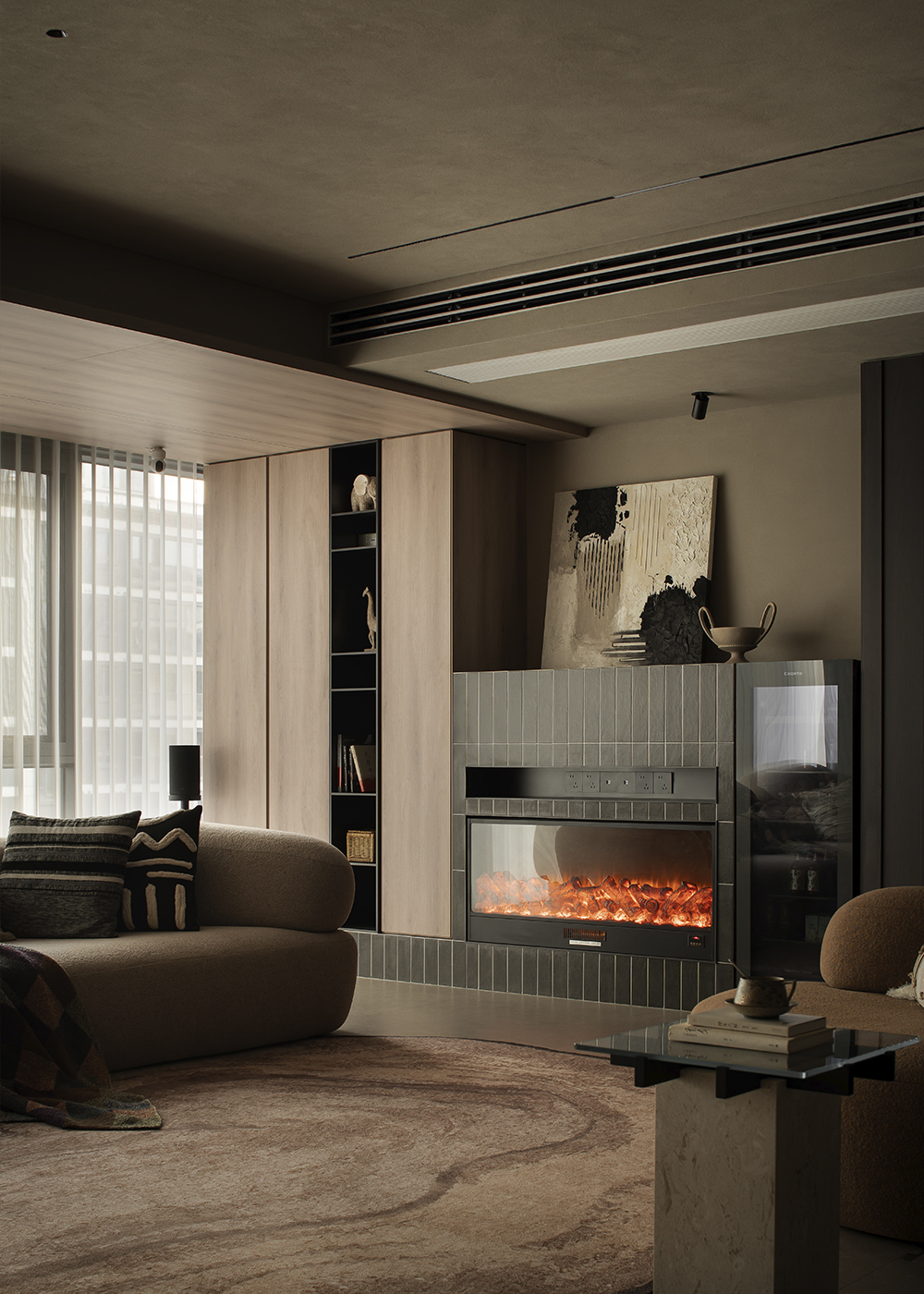
The conceptual origin of this project is deeply rooted in Su Shi’s Xing Xiang Zi, particularly the line, “Who can remain free of worldly affairs, quietly seated in the empty mountains?” More than a reflection of the Song literati’s spiritual outlook, it embodies a spatial philosophy that has been cultivated throughout thousands of years of Chinese culture. Responding to the client’s aspiration for a calm and introspective way of living, the design deliberately moves away from the conventions and decorative excesses of traditional residences. Instead, it returns to a more fundamental inquiry: in the midst of an increasingly noisy city, how can space itself inspire stillness? How can it invite people to pause? And how can it encourage them to rediscover the act of truly seeing the world around them?
Following this philosophical thread, we introduced a conceptual pavilion at the very heart of the floor plan. Transcending the role of a conventional architectural element, it becomes the spiritual anchor of the home. Open on all four sides, the pavilion connects the entrance foyer, living room, dining room, and the passage leading to the private quarters, creating a centripetal spatial organization. This composition dissolves the rigid boundaries between functional zones, allowing each space to retain its own identity while remaining visually and experientially connected through the pavilion. It serves not only as the central node of circulation but also as a place that accommodates both everyday life and moments of quiet contemplation.