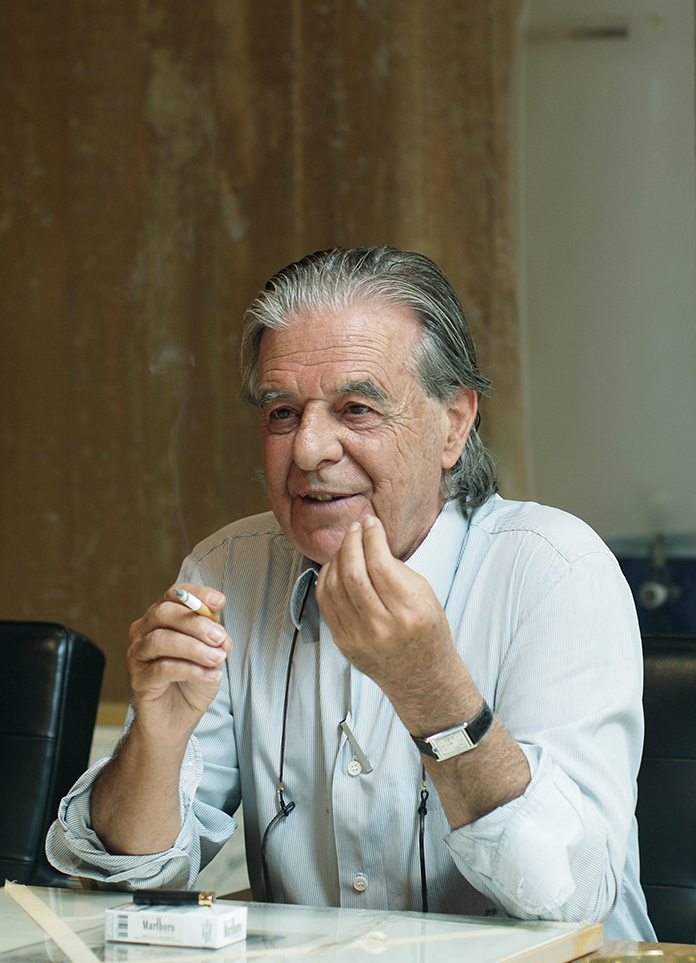
When encountering a client who is also a designer, this collaboration broke free from the conventional “client–designer” framework from the very beginning. It was precisely this resonance of shared identity—and the complete trust it fostered—that allowed us to jointly craft this residence, aptly named “Fulfilled.”

As a renowned fashion designer, the client possesses a clear aesthetic vision and a strong sense of self regarding her home. Meanwhile, I did not participate solely as a spatial designer. This creative process felt more like a dialogue between two like-minded old friends—each having accumulated years of experience—coming together in a mutual response. It became a profound exploration of dwelling, as well as a reflection and investigation into high-rise residential design.

How to transform a standardized, uniform high-rise apartment into the poetic home envisioned by the client became the greatest challenge of this project, and also the central proposition of our in-depth exploration into high-rise residential renovation and design. High-rise buildings are inherently rigid and impersonal, and each unit is merely one of hundreds or thousands of repetitive modules within. This nearly fixed condition of standardized housing rarely evokes emotional resonance or aspirational living for individuals with a strong sense of identity.
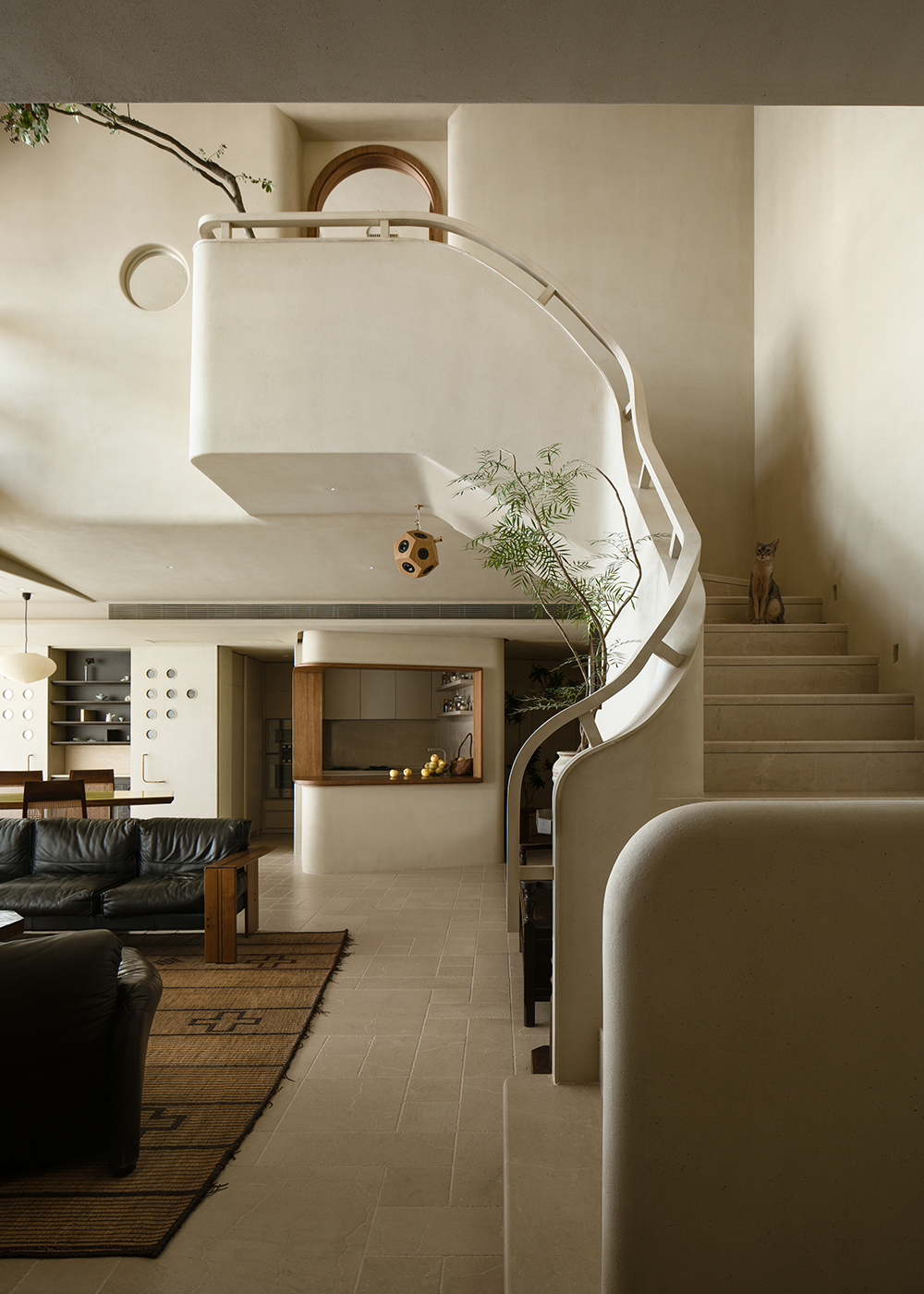
Thus, we chose to set aside the predetermined physical boundaries of the architecture and instead work from within the space, constructing a new form that is fluid, light, and gentle. A staircase with a handcrafted quality not only connects the upper and lower levels, but also creates a relaxed and free spatial atmosphere. The curved ceiling subtly responds to the overall spatial relationship, allowing residents to momentarily forget the constraints of high-rise living. The double-height, expansive front-facing windows frame the outdoor scenery entirely within the interior, effectively extending the visual field and further blurring the physical boundaries of the building. Through the integration of these elements, we ultimately break the stereotypical perception of high-rise residences, allowing even a limited space to hold the poetry and vastness of life.

The construction of spatial functions remains deeply tied to the lifestyle of its inhabitants. After fulfilling emotional aspirations, this becomes our sincere response to practicality. The essence of a home lies in everyday use—this is what fundamentally distinguishes it from exhibition or display spaces. Therefore, usability and suitability become the foremost principles. Within a limited space, we adopted non-standard design approaches to dissolve functional boundaries, achieving both practicality and diversity.

The living and dining areas, together with the entrance, staircase, kitchen, and study, form a relationship of independence and coexistence. Without rigid physical partitions, each functional zone maintains its own specific use scenarios and basic conditions, while also supporting and enhancing one another atmospherically. Together, they merge into a cohesive family social space, capable of accommodating the unpredictability and possibilities of everyday life. All of this stems from the deep mutual understanding and trust between us and the client, allowing the design to adapt fluidly to personal needs and the evolving rhythms of life.

From the moment the client first envisioned transforming her home to the final realization of the design, more than five years have passed. This extended process of refinement has never been solely about personal fulfillment. As designers, we hope that through this profound residential experiment, we can offer young urban dwellers a new perspective on living—a prototype for contemporary life.

In truth, poetry and distance are not somewhere far away; they reside within one’s state of mind. Every individual with a strong sense of self is searching for their own inner condition, exploring ways to express their identity. And the place that can gently hold this state of being, offering a true sense of belonging, can only be home.

MORE PHOTOS