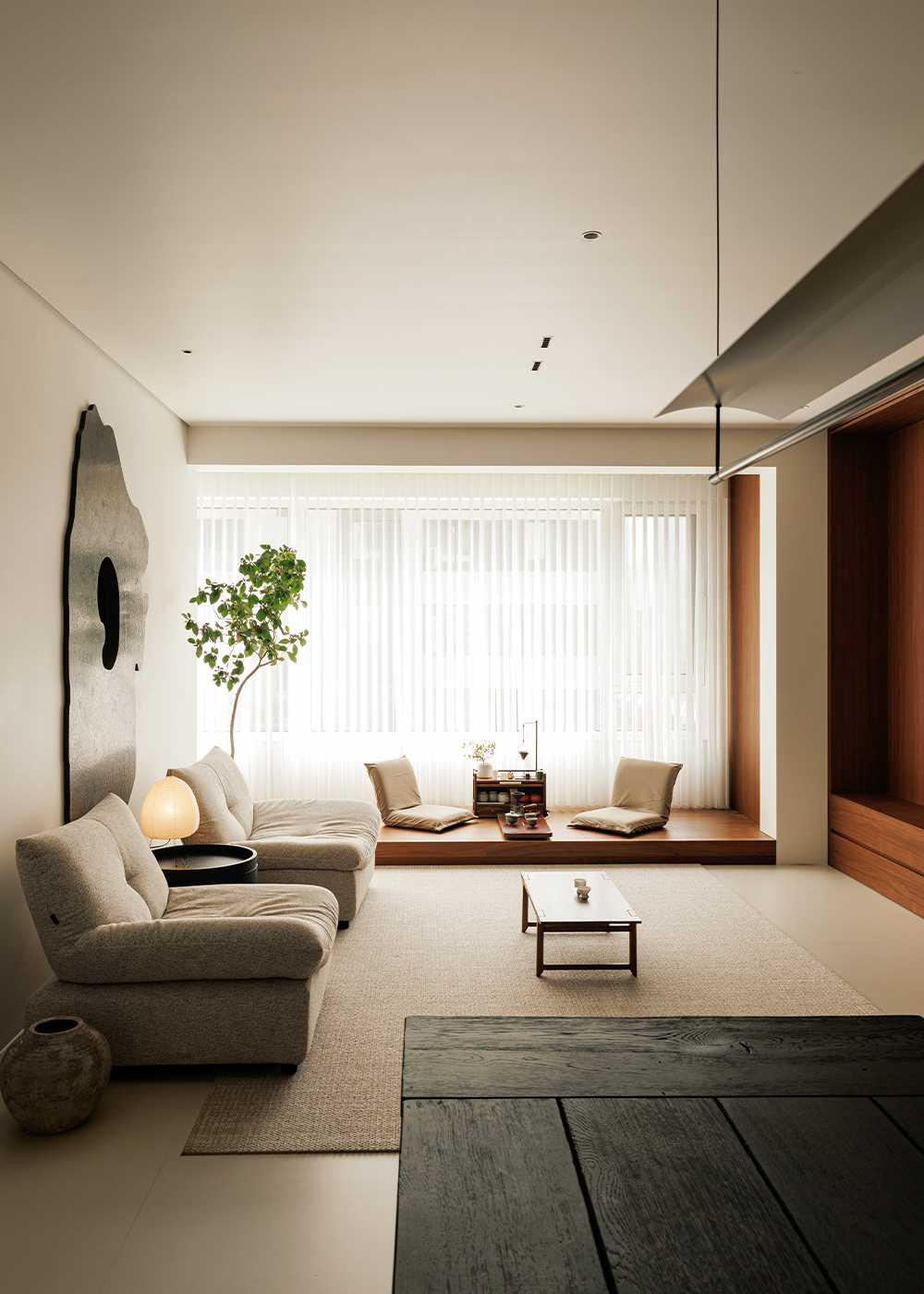
Yóu — to roam — is not a poetic name but a spatial philosophy: the Four Attainables of landscape painting set down by Northern Song master Guo Xi, enacted at their smallest scale within a two-person home in Tangshan.
The owners — a couple — began the commission with a memory: a tea gathering at the Huayi Hotel in Shanghai, dinner finished, the two of them settled across from one another with cups in hand. "The tabletop, the tea tray, the tea ware, the kettle — everything carried a sense of quality that was also completely at ease." They hoped their home might feel the same: relaxed, open, reassuring, warmly unhurried. Rather than answering with a style, we turned to a standard — the "Four Attainables" in Guo Xi's Lofty Aspirations in Forests and Streams: a landscape painting reaches its highest order when the eye can traverse it, gaze through it, wander within it, and come to rest.
A House is also a Garden — not only the title of Jin Qiuye's book, but the working premise for this project's spatial logic. Classical Chinese gardens operate through borrowed views, framed vistas, and shifting scenes at every step; each design decision here is a contemporary translation of garden-making into a single-level residence. Past the entry walnut wall set with six circular fluted-glass roundels, through the threshold and into the study, an arched opening in the desk's side panel faces, across the sightline, a cavity in the living room's natural black stone slab — a stone whose presence recalls Ruiyun Peak in Suzhou's Lingering Garden. The two apertures mirror each other like sections of a single mass: jiejing — borrowed scenery — transposed from garden to interior.