During our communication with Marina Salles, the first thing we sensed was a clear stance regarding "the integrity of life". The Studio told us that the goal of the renovation was not merely to update the space itself, but to re-activate a living style that was gently enveloped by time - integration, comfort, warmth, and a naturally flowing sense of happiness. In their view, an ideal home should be one where everything in sight is attractive: it not only brings sensory relaxation but also responds implicitly to the functional needs of daily use. This restrained and delicate design approach has enabled the Laranjeiras House, after renovation, to retain its original intimate atmosphere while also becoming more composed and complete.

When discussing the renovation strategy for this residential building located in a coastal environment, the Studio further pointed out that climate and humidity are not limitations; instead, they are crucial factors that drive the design decisions. They informed us that in the selection of materials and the construction process, durability and ventilation performance are placed at the core, and great emphasis is also placed on the accuracy of the craftsmanship and execution. When dealing with spaces that carry family memories, the design is not a complete overhaul but rather a dialogue about trade-offs - which should be retained and which need to be continued in a "new version". Through such judgments, this residential building is able to find a balance between the continuity of time and contemporary intervention, preserving the warmth of memories while also launching a new narrative of life.

Laranjeiras House, located within a private residential community in Paraty, on the southern coast of Rio de Janeiro state, is a summer home whose architecture, completed in 2009, bears the signature of the former firm Bernardes + Jacobsen — an important name in contemporary Brazilian architecture. Over time, the house became intertwined with the family’s history, witnessing the children grow into adulthood and establishing itself as the setting for recurring holidays and gatherings.
As the years passed, the need arose for interior updates and targeted interventions to improve comfort, adapt the spaces to new uses, and restore materials affected by sea air corrosion and the humid coastal climate — conditions typical of Brazil’s shoreline. It was in this context that Studio Marina Salles Arquitetura e Interiores was invited to lead the renovation, taking on the challenge of reinterpreting the residence without altering its essence or the character of the original design.

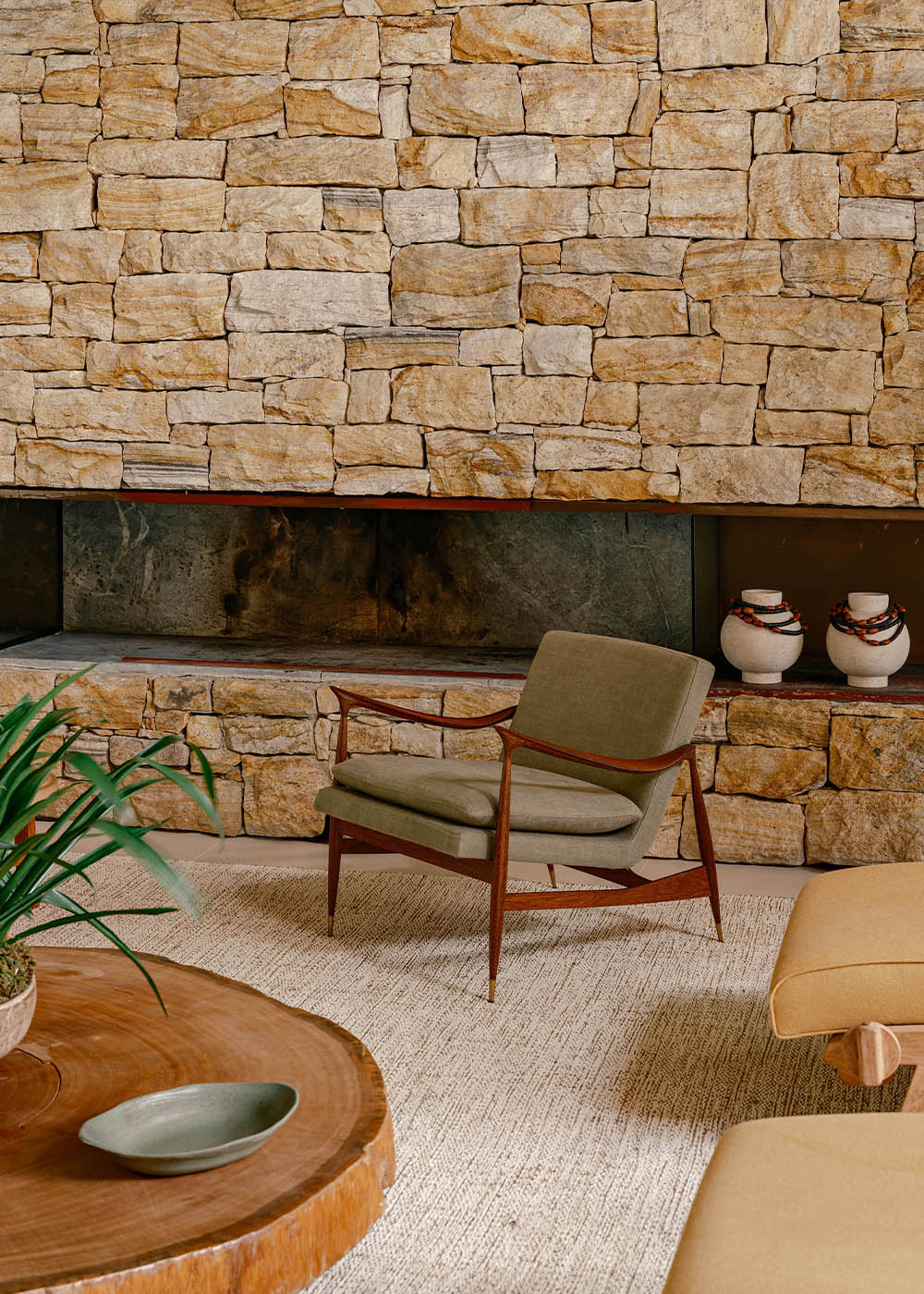
On the ground floor, the living and dining rooms received special attention. Most of the existing furniture was retained and restored, reinterpreted through new upholstery, rugs, and a carefully curated selection of objects and lighting. The sofas, the pair of Jung chaises by Brazilian designer Etel Carmona, and armchairs from the family’s own collection were upholstered in neutral tones — off-white and earthy hues — while cushions in greenish shades establish a subtle dialogue with the surrounding vegetation. Artworks and handcrafted pieces were arranged to reinforce the relaxed atmosphere of a summer retreat.

The veranda, a natural extension of the living areas — an essential feature in Brazilian coastal homes — had its sofas and pair of armchairs by Brazilian designer Carlos Motta restored with new fabrics and cushions in sand and blue tones. The coffee table, specially designed by Marina Salles in solid wood, features hand-painted ceramic pieces by artist Flávia Del Pra set into its surface. The custom wood paneling was restored and adjusted, while the gourmet counter received a new stone countertop.

The kitchen was completely renovated with new finishes. Custom millwork combines slatted and ventilated cabinetry — an important detail in humid climates — with lower modules in natural wood painted white and upper cabinets in natural wood with framed glass doors to display tableware. Shelving with integrated lighting completes the composition. The countertops and wall tiles are in an off-white tone, contributing to the bright, airy atmosphere sought for the space.

On the upper floor, the mezzanine houses the family room, where the large sofa was reupholstered in terracotta fabric with cushions in tonal variations. A new low cabinet with niches and doors, designed by the studio, brings lightness to the space, replacing a former floor-to-ceiling bookcase.

The bedrooms and suites were carefully updated to meet the comfort and practicality required in a beach residence. The walls feature an off-white mineral paint developed by Atelier Paola Croso, adding subtle texture and a warmer visual effect. The finish dialogues with the home’s natural material palette.

Wood headboard panels with indirect lighting, upholstered bed headboards for greater comfort, new bedside tables, and bed linens in earthy tones ensure a welcoming atmosphere. Guest-suite wardrobes were designed with practicality in mind, incorporating shelves, few drawers, and roller blinds in synthetic woven fabric; in other suites, the millwork features wooden structures with doors in synthetic woven cane, promoting constant ventilation — an important factor in coastal environments. Family photographs were redistributed throughout the rooms, preserving memories and creating aesthetic continuity. Each suite maintains its own identity while respecting the home’s overall neutral and earthy color palette.

In the bathrooms, the original layouts were preserved, while all finishes and millwork were renewed. Floors and walls were clad in sand-toned ceramic tiles, and niches and countertops were executed in Silver Travertine. The mirrors feature wooden frames and indirect lighting systems. In the primary bathroom, a double-sink vanity with a full cabinet — including drawers and slatted doors for enhanced ventilation — connects to the closet area, which features doors in synthetic woven cane.

Studio Marina Salles’ intervention reinforces a dialogue between eras: each detail respects the original architecture while incorporating technical improvements, more durable materials, and contemporary solutions. The residence remains a gathering place for family and friends, functioning equally well for moments of conviviality and for silence and contemplation, preserving its role as both a weekend refuge and a summer home on Brazil’s coast.

MORE PHOTOS