Architecture studio Ortega Diago transforms the seventh floor of a historic building in San Sebastián to create a serene residence defined by a spatial sequence, continuous stone materiality, and light that sculpts the space.

Architecture studio Ortega Diago, founded by Gonzalo Sánchez Ortega and Armando Diago, presents Casa Kendo. Located on the seventh floor of a late 19th-century building in San Sebastián, the intervention leverages the height and privileged orientation to turn natural light into the project's true driving force, shaping a serene residential space with a quiet, contemplative atmosphere.

Far from attempting to reconstruct a historical past or stage a forced relationship with the building's original context, the proposal turns its focus inward. The project explores the different scales coexisting within the floor plan and how they are traversed, prioritizing the inhabitant's experience over ornamentation.

The organization of the home follows a clear logic where every decision seeks to be essential. The project rethinks the traditional role of the hallway, usually relegated to a residual passageway. In Casa Kendo, this element acquires "thickness and character": it widens, approaches the rooms, and participates in them.
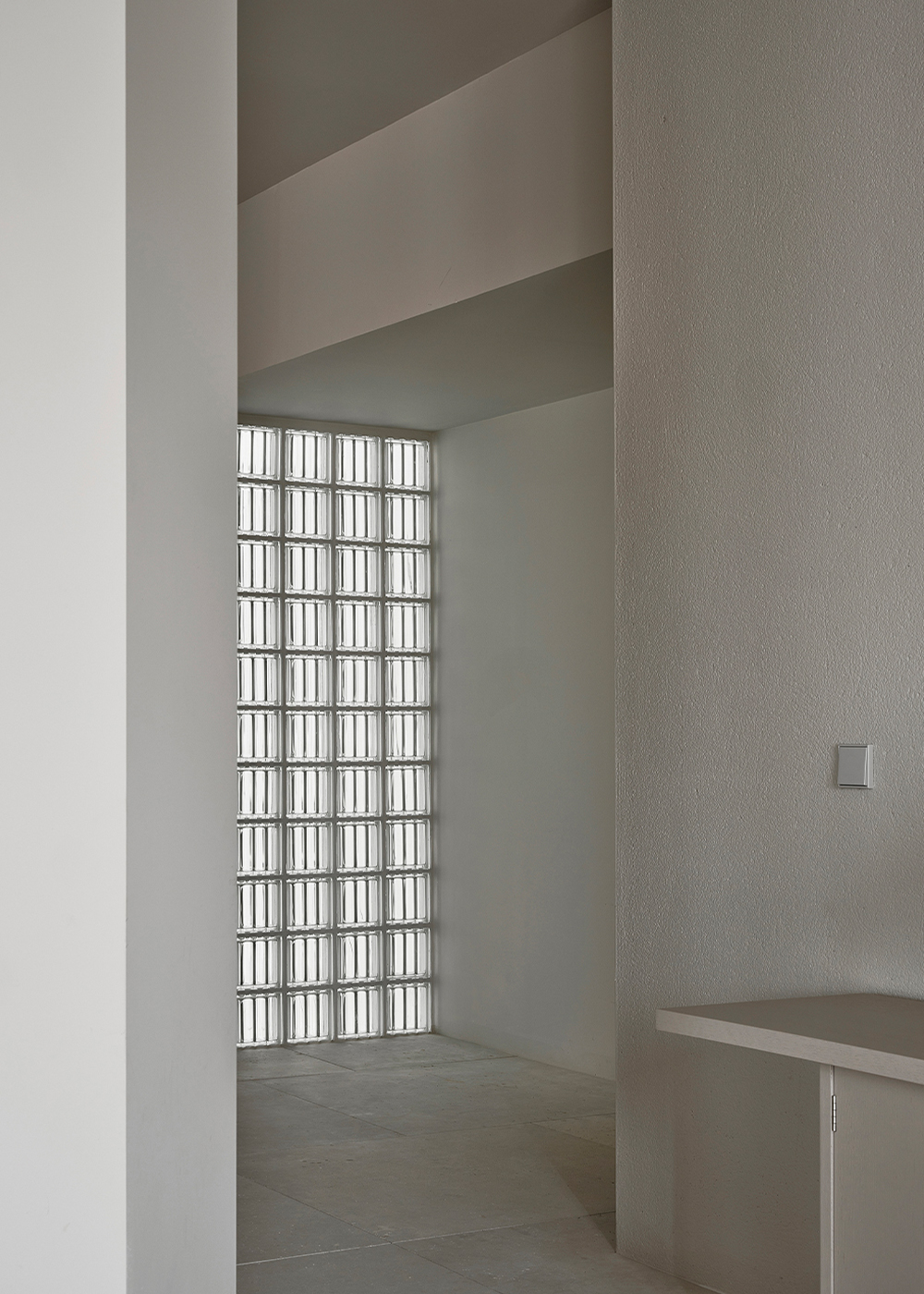
More than just a distributor, it functions as a backbone that structures life in the house through bold volumes. This spatial sequence is enriched by the punctual use of glass block screens that sift the light, introducing a different texture that breaks the solidity of the walls and enhances visual continuity.

The project's materiality pursues an atonal appearance that accompanies the light without competing with it. The studio selected sandblasted Campaspero stone as the unifying element. This material unfolds as a continuous plane—across flooring and vertical cladding—capable of absorbing the intense seventh-floor light and reflecting it back in a softened manner.

This design strategy makes full sense at sunset: "When the afternoon light glides over its surface, the space acquires an unexpected, almost intimate density," the studio explains. Thus, a serene stage is built for daily life, where architecture accompanies without imposing itself.

Under this premise of serenity, the interior design is completed with a careful selection of furniture that dialogues with the sobriety of the stone. Iconic pieces by Fritz Hansen (such as the Ant chairs and the dining table) or the Akari lamp by Vitra coexist with contemporary designs like the Scandia chair by Fjordfiesta.

Of particular note is the integration of the studio's own design, such as the Tarugo Chair by Ortega Diago, which adds a unique character to the ensemble. Technical and decorative lighting featuring pieces by Álvaro Siza, along with Vola fixtures, round off a project that invites one to rediscover the everyday and establish a conscious relationship with the space.

MORE PHOTOS