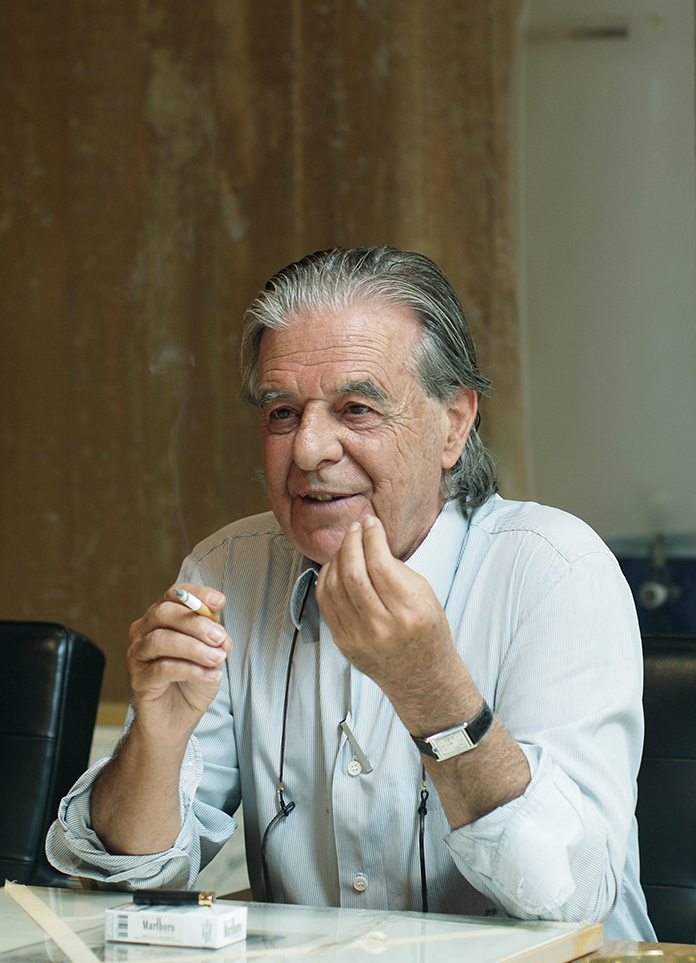
In our conversation with YAMA Architects, they told us that “architecture is never an isolated object, but rather something that continuously engages in dialogue with its environment and the way people live.” In the design of Residence AV, they sought to give the building a restrained yet clearly defined presence within its site. As YAMA Architects explained to us, the core of their work lies in the search for “coherence” — an intrinsic unity between the building, the landscape, and the people who inhabit it. In this sense, architecture is no longer merely a container of space, but an order shaped by light, scale, and material. Within this order, people are able to naturally perceive the layers, distances, and rhythms of space.

When speaking about the experience of residential space, YAMA Architects believe that a truly powerful home does not rely on immediate visual impact, but rather on a spatial experience that unfolds gradually. As they told us, designing a house is much like walking through a landscape: spaces reveal themselves progressively as one moves through them, light changes throughout the day, and views continually shift between moments of compression and openness. Within this rhythm, the house slowly establishes a calm and stable atmosphere. For them, architecture should ultimately provide a quiet framework for living — one that accommodates everyday life, brings warmth, and allows people to feel a sense of authenticity and balance.

Set within a dense residential neighbourhood, this project responds to a paradoxical brief: a strong desire for connection to the surrounding context, paired with an equally strong need for privacy. The client, living alone, was drawn to the social presence and sense of safety offered by the neighbourhood, yet sought a home capable of withdrawing from direct views and fostering a more introspective way of living.
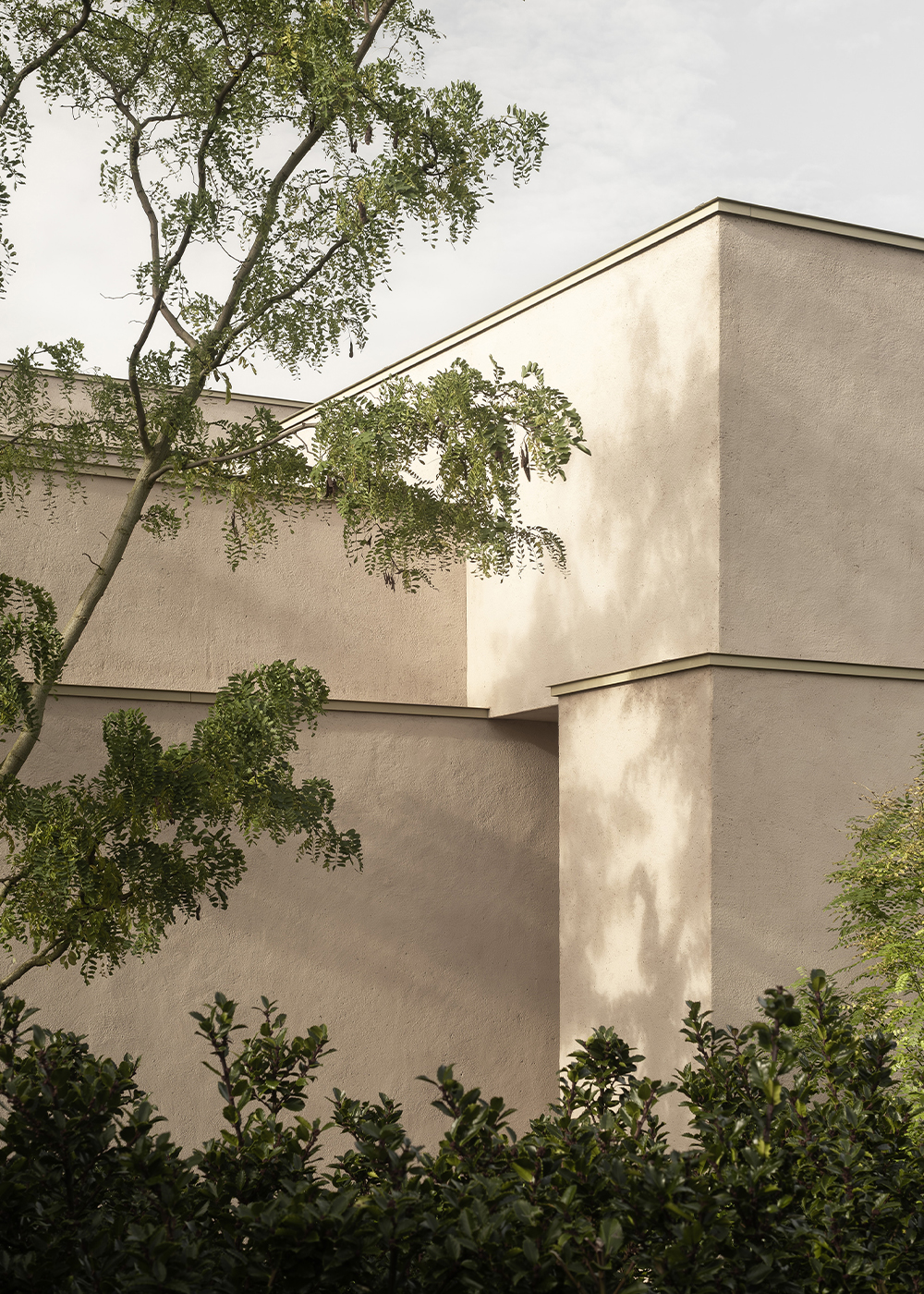
Rather than resisting the constraints of proximity, the project embraces them. Privacy is not achieved through distance or opacity alone, but through spatial sequencing, orientation, and an inward-looking architectural logic. This approach led to the development of a patio house, where the traditional emphasis on front or back gardens is replaced by an enclosed garden at the heart of the dwelling. The patio forms the core of the house—both physically and experientially. All primary living spaces are arranged around this inner garden, allowing light, air, and seasonal change to penetrate deep into the home while maintaining a strong sense of enclosure.

The living room and kitchen face one another across the patio, establishing a constant visual dialogue. This configuration generates a layered perception of space, where the architecture remains continuously present. Moving through the house becomes an act of looking back at it. The experience oscillates between inside and outside, foreground and background, observer and inhabitant.

Daylight enters indirectly, filtered by depth and enclosure. Walls temper its intensity; planting softens its reflection. Light is not dramatized but allowed to settle and linger. Over the course of the day, brightness migrates quietly across surfaces, marking time through nuance rather than contrast. The patio becomes a reservoir of light, absorbing and redistributing it with subtlety.

A restrained material palette binds the interior together. Repetition is employed not for uniformity, but for calm. Surfaces flow seamlessly from one space to the next, allowing light and texture to take precedence over form. Transitions are softened, and distinctions are made through proportion and tactility rather than contrast.

Anchoring the ground floor, the kitchen maintains a steady relationship with the patio. Its materiality introduces a sense of permanence: stone and timber are applied with clarity and precision. Details are absorbed into the whole—edges, joints, and handles recede—so that interaction is registered through touch rather than visual emphasis.

The upper level accommodates the most intimate functions of the house. Here, the architecture withdraws further, allowing stillness to dominate. Light becomes more subdued, textures more tactile. While material continuity ensures coherence with the lower floor, subtle atmospheric shifts signal a change in rhythm—from shared to private, from active to contemplative. The spaces support rest not through isolation, but through quiet composure.

Throughout the house, custom-designed furniture is carefully embedded within the architecture, forming places to dwell, work, and gather. Rather than fixed functions, these elements are conceived as polyvalent moments, shifting naturally from desk to reading table, from workspace to bar.

This project reflects a deliberate shift in focus—from outward expression to inward experience. Within a dense residential context, the house establishes its own quiet order, shaped by light, proportion, and restraint. By centring daily life around an enclosed garden, the architecture creates a condition in which privacy and openness coexist. Spaces are not defined by excess, but by careful omission—allowing atmosphere, material, and time to take the lead. Rather than seeking to stand apart, the house finds strength in subtlety: an architecture of presence rather than display, offering a composed framework for living—attentive, inward, and enduring.

MORE PHOTOS